
User manual for SARAD's RTM 2200, RPM 2200, EQF 3200, and EQF 3220 instruments based on DACM technology for environmental and radiological monitoring.
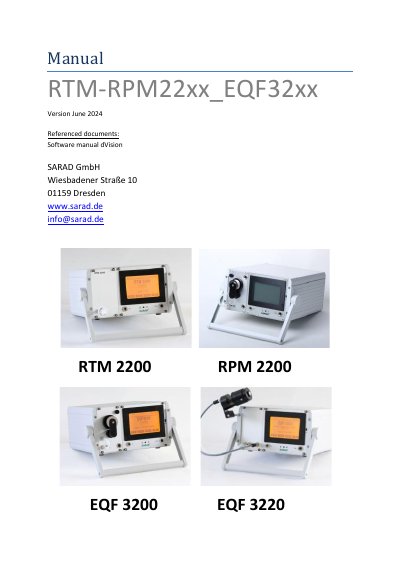
This manual covers operation and configuration of SARAD’s RTM 2200, RPM 2200, EQF 3200, and EQF 3220 instruments using DACM technology. It explains sampling control, component configuration, data flow, alert management, and PC interfacing via dCONFIG and dVISION software. Chapters detail specific components like radon chambers, gamma detectors, and gas sensors, including setup, operation, and calibration procedures.
The manual also covers instrument setup, data storage (SD card), menu navigation, GPS integration, and technical data. It is designed for users to customize instrument functions and adapt them to specific applications without hardware changes.
| Sampling Control | Cycle subdivisions up to 32, configurable per subdivision |
|---|---|
| Alert Management | Alerts checked once per second, configurable per component |
| PC Interfacing | dCONFIG for configuration, dVISION for operation |
DACM is a universal platform for instrumentation based on data acquisition and control modules, allowing customization without hardware changes.
The cycle can be split into up to 32 subdivisions, each configurable with component states via control bits or words.