
A reliable instrument for evaluating ground engineering problems via in-situ loading tests, featuring rugged construction and no compressed gas requirement.
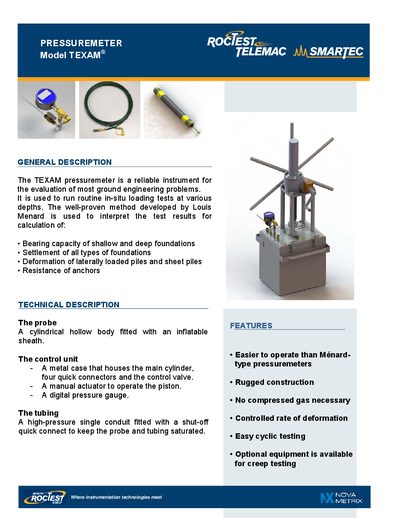
The TEXAM pressuremeter is a reliable instrument designed for the evaluation of most ground engineering problems. It utilizes the well-proven method developed by Louis Menard to interpret test results for calculating bearing capacity, settlement, and deformation of piles and anchors. The device consists of a cylindrical hollow body with an inflatable sheath, a control unit housing a main cylinder and digital pressure gauge, and high-pressure tubing.
| Working pressure (max.) | 10 000 kPa (1500 psi) |
|---|---|
| Gauge precision | 0.05% FS |
| Gauge resolution | 1 kPa |
| Actuator capacity | 10 tons |
| Control unit dimensions | L = 40 cm W = 46 cm H = 45 cm |
| Control unit weight | 30 kg |
| Actuator weight | 28 kg |
| Probe NX Long diameter | 74 mm |
| Probe NX Long length | 72 cm |
| Probe NX Long weight | 6.4 kg |
| Probe AX diameter | 44 mm |
It is used to run routine in-situ loading tests at various depths to evaluate bearing capacity, settlement, and deformation of piles and anchors.
No, it does not require compressed gas.
Tubing is available in lengths of 25m, 33m, and 50m.