
The Robotis TurtleBot3 User Manual provides installation, configuration, operation, and troubleshooting instructions for the Burger and Waffle models.
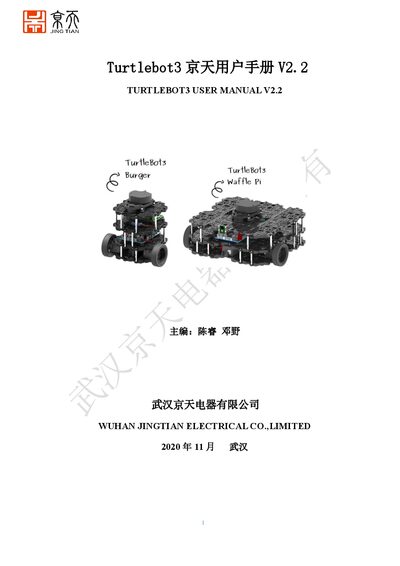
This manual covers the hardware features of the TurtleBot3 platform, including dimensions, payload, battery, and sensor specifications for the Burger and Waffle variants. It also explains how to assemble the robot and install the required firmware on the OpenCR board.
Detailed steps are provided for setting up a remote PC with Ubuntu 16.04 and ROS Kinetic, installing the Raspberry Pi operating system, configuring network connections, and running ROS launch files for SLAM, navigation, simulation, and keyboard control. Troubleshooting tips and common issues are listed at the end of the document. This manual is written in Chinese.
| Maximum linear speed | 0.22 m/s (Burger) / 0.26 m/s (Waffle) |
|---|---|
| Maximum angular speed | 2.84 rad/s (Burger) / 1.82 rad/s (Waffle) |
| Maximum payload | 15 kg (Burger) / 30 kg (Waffle) |
| Dimensions (L×W×H) | 176 × 138 × 188 mm (Burger) / 306 × 283 × 143 mm (Waffle) |
| Weight | 1 kg (Burger) / 1.8 kg (Waffle) |
| Battery | Lithium‑polymer 11.1 V 1800 mAh (19.98 Wh) |
| Charging adapter | Input 220 V AC 50/60 Hz 1.5 A, Output 12 V DC 5 A |
| Obstacle clearance | 10 mm |
| Continuous operation time | 2 h (Burger) / 30 min (Waffle) |
Install Ubuntu 16.04 on the remote PC, then run the ROS Kinetic installation script as described in sections 2.1 and 2.2 of the manual.
Run `roslaunch turtlebot3_bringup turtlebot3_robot.launch` and then launch RViz with the model file using `rviz -d $(rospack find turtlebot3_description)/rviz/model.rviz`.