
The RIGOL RP1050H User's Guide covers safety warnings, operation, cleaning, and specifications for the 1:1000 high voltage oscilloscope probe.
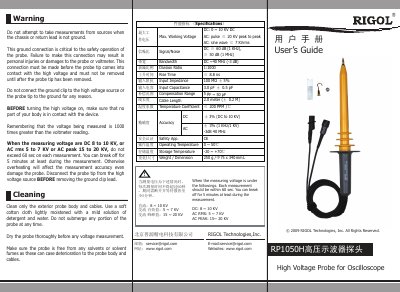
This user’s guide is for the RIGOL RP1050H high voltage oscilloscope probe with a 1:1000 division ratio. It includes safety warnings, operating instructions, cleaning guidance, and the product’s performance specifications.
The document warns that the ground connection must be made before the probe tip contacts high voltage and removed only after the tip is removed. It also lists maximum working voltage, bandwidth, input impedance, and other technical specifications. This manual is written in Chinese.
| Max. Working Voltage DC | 0 ~ 10 KV |
|---|---|
| Max. Working Voltage AC Pulse | ≤ 20 KV peak to peak |
| Max. Working Voltage AC Sine | ≤ 7KV rms |
| Signal/Noise | DC ≥ 60 dB (1 KHz), ≥ 50 dB (1 MHz) |
| Bandwidth | DC ~40 MHz (-3 dB) |
| Division Ratio | 1:1000 |
| Rise Time | ≤ 8.8 ns |
| Input Impedance | 100 MΩ ± 5% |
| Input Capacitance | 3.0 pF ± 0.5 pF |
| Compensation Range | 5 pF ~ 50 pF |
| Operating Temperature | 0 ~ 50℃ |
| Storage Temperature | -20 ~ +70℃ |
The maximum DC working voltage is 0 ~ 10 KV.
Each measurement should be within 60 seconds, with at least a 5-minute break for cooling.
The probe has a division ratio of 1:1000.
Clean only the exterior with a soft cotton cloth and a mild detergent and water solution; do not submerge the probe.