
Installation, operation and maintenance guide for Pulsafeeder Eclipse Series pumps handling hazardous chemicals.
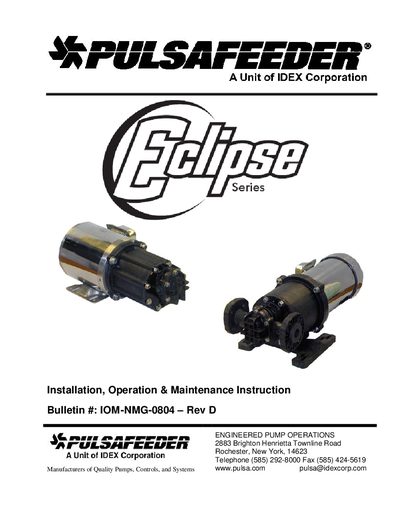
This manual provides comprehensive guidance for the safe installation, proper operation, and routine maintenance of Pulsafeeder Eclipse Series pumps. It includes safety considerations, equipment inspection, storage procedures, and detailed installation steps to ensure reliable performance in hazardous, corrosive, explosive or toxic environments.
The document also contains model‑specific specifications, disassembly/assembly instructions for each pump size, troubleshooting charts, bolt‑torque recommendations, parts diagrams, O‑ring references, dimensional drawings, performance curves, and ATEX compliance information.
| Maximum Differential Pressure (Eclipse 2) | 150 psig (10 bar, 1034 kPa) |
|---|---|
| Maximum Differential Pressure (Eclipse 5) | 150 psig (10 bar, 1034 kPa) |
| Maximum Differential Pressure (Eclipse 12) | 150 psig (10 bar, 1034 kPa) |
| Maximum Differential Pressure (Eclipse 25) | 150 psig (10 bar, 1034 kPa) |
| Maximum Differential Pressure (Eclipse 75) | 150 psig (10 bar, 1034 kPa) |
Read and understand all related instructions, observe all warnings and notes, and follow applicable safety and work procedures during installation, adjustment, and maintenance.
Leave the pump in its original shipping carton, store it indoors in a dry ambient atmosphere, avoid temperature variations, and keep all shipping plugs in place.
All Eclipse Series pumps are rated for a maximum speed of 1750 rpm.
Do not run the pump dry; a dry run can cause rapid temperature rise and damage, so ensure suction is maintained before start‑up.