
This manual provides instructions for developing Natural Language interfaces using the Phoenix parser, covering theory, grammar writing, and compilation.
The Phoenix parser is designed to develop simple, robust Natural Language interfaces to applications, especially spoken language applications. It maps input word strings onto a sequence of semantic frames by matching grammars against words using Recursive Transition Networks (RTNs). The developer must define frames and provide grammar rules that specify the word strings for each slot in a frame.
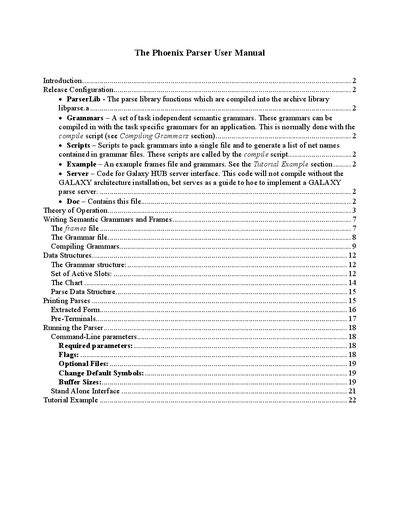
The manual covers the theory of operation, writing semantic grammars and frames, compiling grammars, data structures, running the parser with command-line parameters, and includes a tutorial example. It explains how to create frames using a specific syntax and defines the notation used in grammar files.
It is designed for the development of simple, robust Natural Language interfaces to applications, especially spoken language applications.
The parser requires two input files: a frames file and a grammar file.
A frame definition is terminated by a semicolon at the start of the line.