
This Philips Lumileds article explains how to use LED datasheet tools to compare power LEDs under real operating conditions.
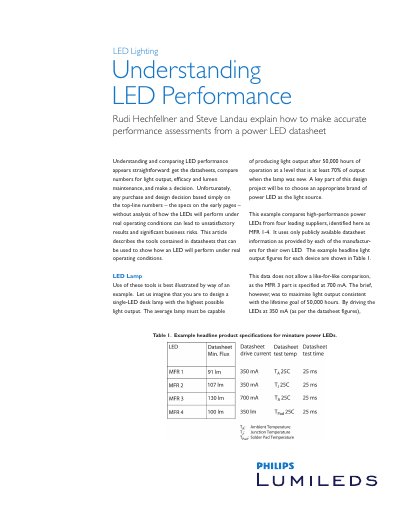
This article describes tools contained in LED datasheets that show how an LED will perform under real operating conditions. It uses a single-LED desk lamp example that compares high-performance power LEDs from four suppliers identified as MFR 1-4.
The article discusses flux normalisation, temperature derating, and lumen maintenance. Under the example conditions, the MFR 3 part cannot be used, while the MFR 4 LED produces at least 133 lumens when new and at least 70% of peak output after 50,000 hours; the MFR 2 part would need 407 mA to meet the same lifetime goal.
Driving the LEDs at 350 mA would not maximise light output for the design.
The MFR 3 part cannot be used because its junction temperature reaches 141°C, 16°C above its maximum rated value.
The MFR 4 LED produces at least 133 lumens when new and at least 70% of peak output after 50,000 hours.
The current must be reduced to 407 mA.