
This document details the Philips I2C bus specification, covering version history, transmission mechanisms, addressing formats, and electrical requirements…
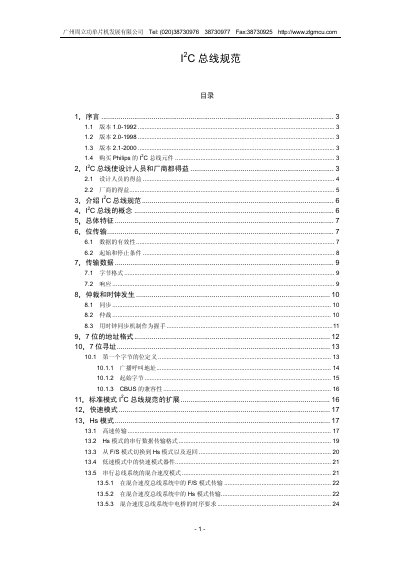
This document is the official specification for the I2C (Inter-Integrated Circuit) bus, developed by Philips. It explains how the two-wire serial bus enables communication between integrated circuits in consumer electronics, telecommunications, and industrial applications. The specification covers the benefits for designers and manufacturers, including reduced pin counts and simplified PCB design. This manual is written in Chinese.
| Standard Mode Bit Rate | 100kbit/s |
|---|---|
| Fast Mode Bit Rate | 400kbit/s |
| High-Speed Mode Bit Rate | 3.4Mbit/s |
| Maximum Bus Capacitance | 400pF |
| Number of Bus Lines | Two (SDA and SCL) |
The document describes Standard Mode (100kbit/s), Fast Mode (400kbit/s), and High-Speed Mode (3.4Mbit/s).
The number of devices is limited by the maximum bus capacitance of 400pF.
The I2C bus was developed by Philips.