
Philips BT134 series E sensitive gate triacs are glass-passivated devices in a plastic SOT82 envelope for general-purpose bidirectional switching and phase…
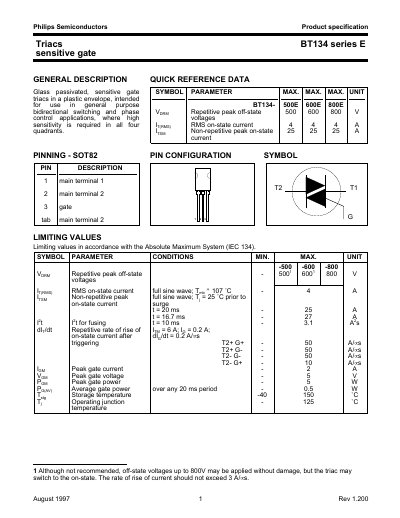
Philips BT134 series E sensitive gate triacs are glass-passivated devices in a plastic envelope for general-purpose bidirectional switching and phase control applications where high voltage sensitivity is required in all four quadrants. The series includes BT134-500E, BT134-600E and BT134-800E variants.
This product specification lists limiting values, thermal resistances, static and dynamic characteristics, and SOT82 mechanical data for the devices.
| Repetitive peak off-state voltage | 500 / 600 / 800 V |
|---|---|
| RMS on-state current | 4 A |
| Non-repetitive peak on-state current | 25 A |
| Thermal resistance junction to mounting base | 3.0 K/W (full cycle) |
| Gate trigger current (T2+ G+) | 2.5 mA typical, 10 mA max |
| On-state voltage | 1.4 V typical, 1.70 V max at 5 A |
| Gate trigger voltage | 0.7 V typical, 1.5 V max |
| Storage temperature | -40 to 150 C |
| Net mass | 0.8 g |
The RMS on-state current rating is 4 A.
They are glass-passivated triacs in a plastic envelope.
The storage temperature range is -40 to 150 C.
It is 2.5 mA typical and 10 mA maximum.