
Pangolin Mach-DSP servo driver user's manual covering specifications, connectors, fault monitoring, servo control software, built-in tools and tuning.
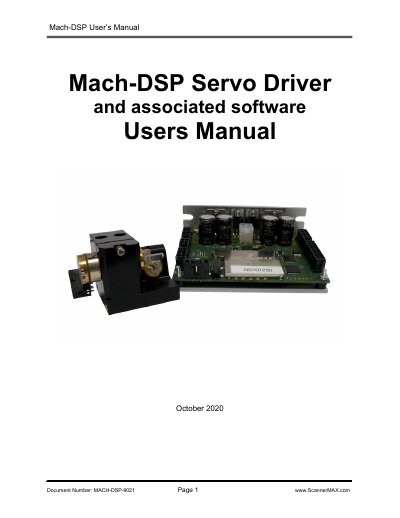
This 98-page user's manual (document number MACH-DSP-9021, October 2020) covers the Mach-DSP, a two-axis servo driver from Pangolin used with ScannerMAX scanners. It explains how the driver is built around high-speed floating-point digital signal processors, 16-bit data converters and direct digital command input, and how it can be configured from a PC-based graphical user interface with more than 50 performance parameters per axis.
The manual walks through specifications, dimensions and mounting, connector locations and functions, fault monitoring and indicator lights, servo theory and configurations, command input waveforms, the Mach-DSP Servo Control application program, built-in tools such as the test signal generator, oscilloscope and dynamic signal analyzer, and step-by-step servo tuning instructions. Compliance statements for RoHS, REACH and CE close the document.
| Analog Differential Voltage Range | ±10 volts differential for full scale |
|---|---|
| Analog Input Impedance | 20KΩ differential |
| Digitizing resolution | 16-bits for all analog inputs and outputs |
| Power Supply Voltage | ±12V to ±30V DC (version dependent); standard version requires ±24V |
| Quiescent Current | +200mA, -230mA (servo enabled, galvos at rest) |
| Dynamic Current (per axis) | up to 5 Amps RMS; 10 Amps Peak |
| Programmable TTL Inputs | two separate optically-isolated inputs |
| User-assignable Analog Outputs | six outputs; ±5 volts; user-adjustable scale |
| Operating Temperature Range | 0°C to 60°C |
| Size (W x L x H) | 2.95" x 3.94" x 1.3" (75mm x 100mm x 33mm) |
| Mass | 170 grams |
It is Pangolin's servo driver that provides full-function, two-axis servo driver electronics in a compact package, built with high-speed floating-point DSPs and 16-bit data converters.
The standard version can run from ±18V to ±30V, but ±24V is required for optimal large-signal performance.
Performance parameters can be stored in four separate memory areas called tunings, for instant access and recall.
It is accessed and configured using a PC-based graphical user interface software package, which includes a test signal generator, oscilloscope and dynamic signal analyzer.