
The Ortovox 3+ is a digital 3-antenna avalanche transceiver with Smart-Antenna technology, 40 m reception range, and a RECCO reflector.
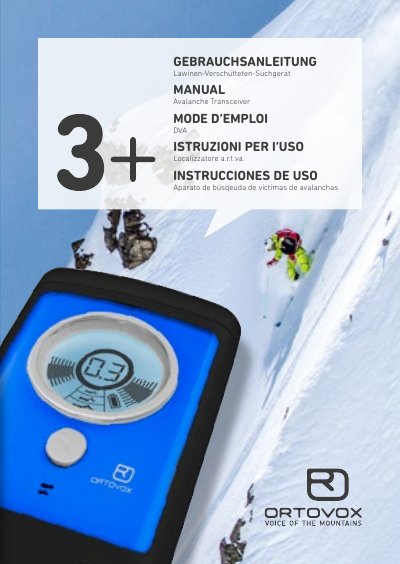
The Ortovox 3+ is a digital avalanche transceiver made in Germany. It uses patented Smart-Antenna technology with three antennas (X, Y, Z) and automatically switches to the best transmission antenna so the user is easier to find. The illuminated real-time display shows the search direction, distance, and number of buried victims.
The transceiver has a digital reception range of 40 m and a search strip width of up to 40 m. It operates from -20 °C to +45 °C, includes a RECCO reflector as backup, runs on a single battery, and is updateable. This manual is written in German.
| Name | ORTOVOX 3+ |
|---|---|
| Function | digital |
| Casing | ergonomic, waterproof, impact resistant |
| Size | 119 x 71 x 25 mm |
| Frequency | 457 kHz |
| Digital reception range | 40 m |
| Search strip width | up to 40 m |
| Temperature range | -20° C to +45° C |
The digital reception range is 40 m.
Yes, it has a RECCO reflector inside that makes the user easier to find.
The temperature range is -20° C to +45° C.
It automatically switches to the best transmission antenna, improving range and visibility.