
User manual for CDI-pio, a parallel I/O extension for Climate Data Interface used in Earth System Models.
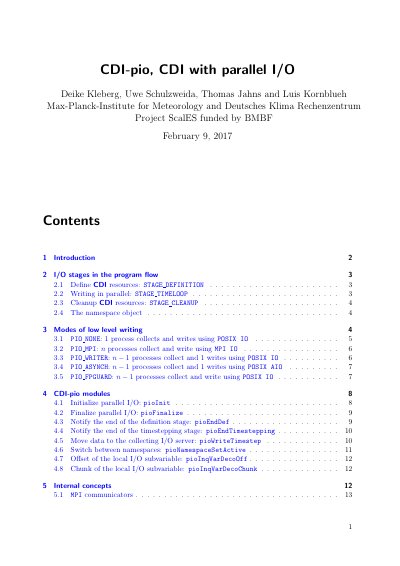
This document describes the CDI-pio module, which extends the Climate Data Interface (CDI) with parallel I/O capabilities. It outlines I/O stages in program flow, different modes of low-level file writing, and internal concepts like MPI communicators and namespaces. The module provides functions and pseudo code for implementing parallel I/O operations.
The CDI-pio module is designed to improve scalability and performance of Earth System Models by decoupling I/O from model calculation. It supports five I/O modes: PIONONE, PIOMPI, PIOWRITER, PIOASYNCH, and PIOFPGUARD, each with different task allocations among processes. The module maintains backward compatibility with existing CDI calls while introducing new functions for parallel I/O management.
The module provides parallel I/O capabilities for the Climate Data Interface (CDI) library to overcome I/O bottlenecks in Earth System Models.
The CDI-pio extension provides five different I/O modes for parallel file writing.
The PIONONE mode uses the C standard fwrite function for low-level file writing.