
Key facts
- Manuals
- 1
- Languages
- EN
- Last added
- 2026-11-06
Featured Max-Planck-Institute for Meteorology manuals
Max-Planck-Institute for Meteorology CDI-pio I/O Module User Manual
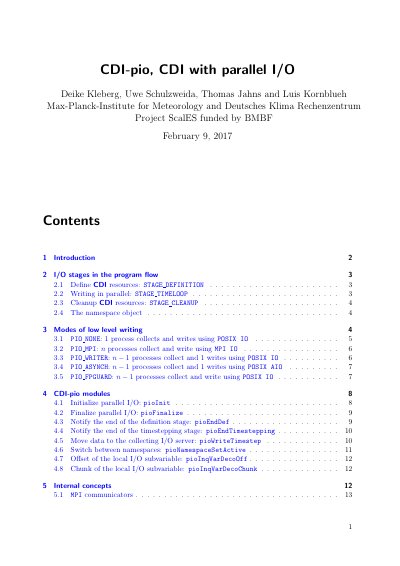
This document describes the CDI-pio module, which extends the Climate Data Interface (CDI) with parallel I/O capabilities. It outlines I/O stages in program flow, different modes of low-level file writing, and internal concepts like MPI communicators and namespaces. The module provides functions and pseudo code for implementing parallel I/O operations.
The CDI-pio module is designed to improve scalability and performance of Earth System Models by decoupling I/O from model calculation. It supports five I/O modes: PIONONE, PIOMPI, PIOWRITER, PIOASYNCH, and PIOFPGUARD, each with different task allocations among processes. The module maintains backward compatibility with existing CDI calls while introducing new functions for parallel I/O management.
Covers: Introduction · I/O Stages in the Program Flow · Modes of Low Level Writing · CDI-pio Modules · Internal Concepts
Latest Max-Planck-Institute for Meteorology manuals
Max-Planck-Institute for Meteorology CDI-pio I/O Module User Manual
User Manual 15 pages · 312 KB · ENUser manual for CDI-pio, a parallel I/O extension for Climate Data Interface used in Earth System Models.
Which document do I need?
User Manual
Day-to-day operation, settings and troubleshooting. Start here if the product is already set up.
Questions answered in Max-Planck-Institute for Meteorology manuals
What is the primary purpose of the CDI-pio module?
The module provides parallel I/O capabilities for the Climate Data Interface (CDI) library to overcome I/O bottlenecks in Earth System Models.
From: Max-Planck-Institute for Meteorology CDI-pio I/O Module User Manual
How many distinct I/O modes does CDI-pio offer?
The CDI-pio extension provides five different I/O modes for parallel file writing.
From: Max-Planck-Institute for Meteorology CDI-pio I/O Module User Manual