
The Lutron Occupancy Sensors Product Guide explains benefits, selection criteria, model options, and compliance with energy codes.
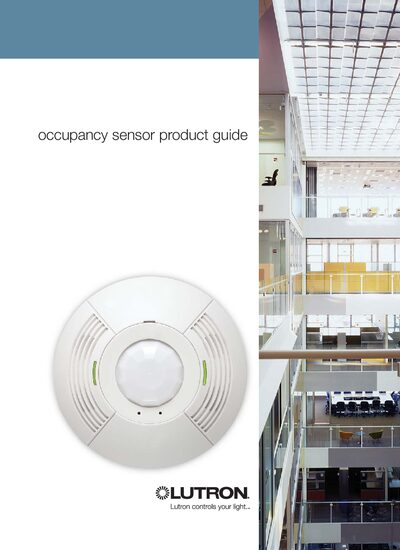
This guide introduces Lutron’s line of occupancy sensors, describing how they automatically switch or dim lighting to reduce energy waste in unoccupied spaces. It covers the advantages of the sensors, code compliance, and integration with Lutron lighting control systems.
The document walks through technology selection (PIR, ultrasonic, dual‑technology), mounting type, coverage considerations, and model families (LOS‑W wall‑mount, LOS‑C ceiling‑mount, power packs). Application examples for offices, classrooms, restrooms and other spaces are provided, along with details on self‑adaptive technology and technical specifications.
| Coverage (LOS‑W series) | 1600 sq ft. when mounted 8‑12 ft. from floor |
|---|---|
| Coverage (LOS‑C series) | 450‑2000 sq ft. when mounted 8‑12 ft. from ceiling |
| Power supply | 20‑24 VDC, Class 2 (PELV) low‑voltage wiring |
| Memory | Non‑volatile memory retains settings after power loss |
| Test mode | 8‑second test mode for operation verification |
They automatically shut off lights within 30 minutes of vacancy, satisfying ASHRAE/IESNA 90.1 and IECC requirements for automatic lighting control.
For stand‑alone use they need a power pack, but when integrated with a Lutron lighting control system they operate without one.