
The Leader LD-YC/YG limit switch is a fork‑type level sensor that installs easily, needs no calibration, and is unaffected by agitation or bubbles.
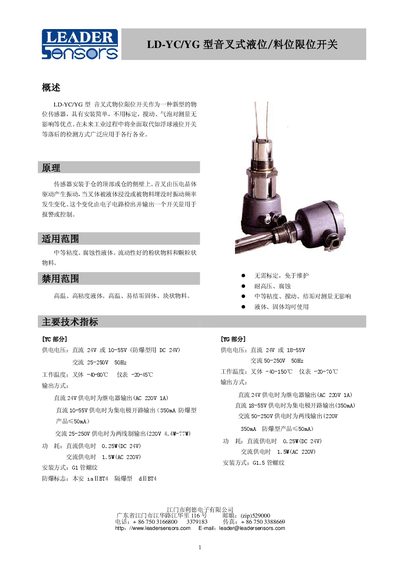
The LD-YC/YG fork‑type limit switch senses liquid or solid levels by using a piezoelectric crystal to drive a vibrating fork. When the fork is immersed in liquid or covered by material, the vibration frequency changes, which the electronic circuit detects and converts into a switch signal for alarm or control.
Key features include simple installation, no calibration required, resistance to high pressure and corrosion, and suitability for medium‑viscosity liquids, corrosive liquids, and free‑flowing powders or granules. Technical specifications cover supply voltage options, temperature ranges, output types, power consumption, and installation methods for both YC and YG versions. This manual is written in Chinese.
| Supply Voltage (YC version) | DC 24 V or 10‑55 V (explosion‑proof DC 24 V), AC 25‑250 V 50 Hz |
|---|---|
| Fork Body Temperature Range (YC) | -40 °C to 80 °C |
| Output Type (YC, DC 24 V) | Relay output (AC 220 V 1 A) |
| Power Consumption (DC supply) | 0.25 W (DC 24 V) |
| Installation Method (YC) | G1 pipe thread |
It uses a piezoelectric crystal to drive a fork that vibrates; when the fork is immersed in liquid or covered by material, the vibration frequency changes, which the electronics detect and output a switch signal.
No, the device does not require calibration.
The YC version can be powered by DC 24 V or 10‑55 V (explosion‑proof DC 24 V) or by AC 25‑250 V at 50 Hz.