
The LT 1611 programmable video generator is a dedicated device for analog RGB signals, supporting analog, digital or analog and digital simultaneous output to meet different usage needs. Its point clock frequency can handle SXGA (1200x1024) and other wide application areas. The device can be changed by the user in its ROM, so it is especially suitable for production lines where the operators cannot change the relevant parameters.
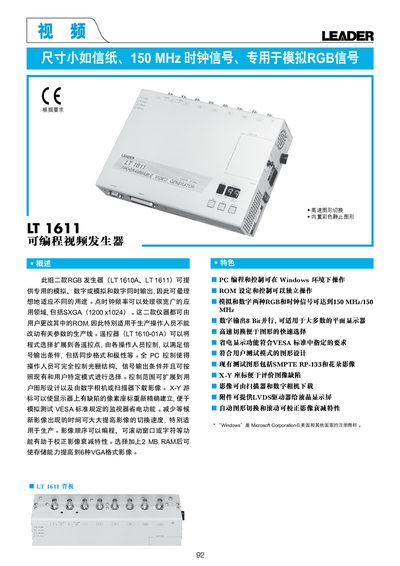
The manual introduces the Leader LT1611 (and LT1610A) RGB video generator, describing its ability to output analog, digital, or combined video signals for a wide range of display resolutions, including SXGA. It explains the built‑in 256‑color VGA graphics, optional RAM expansion, and the use of a PC‑based control interface for full raster and timing control.
Programming can be performed from a Windows PC via the RS‑232C interface, allowing users to upload images, edit timing data in spreadsheet software, and store multiple VGA/XGA static images in RAM. The document also covers remote‑control functions, power requirements, environmental limits, and physical dimensions of the unit. This manual is written in Chinese.
| Analog point clock frequency | 1.024 – 150.000 MHz (10 ppm) |
|---|---|
| Digital clock mode 1 frequency | 1.024 – 75.000 MHz (10 ppm) |
| Digital clock mode 2 frequency | 2.048 – 150.000 MHz (10 ppm) |
| Horizontal frequency | 3.077 – 250 kHz, up to 8192 points |
| Maximum vertical scan lines | 8179 (interlaced) |
| Video memory | 2048 × 2048 points × 4 |
| Analog video output level (R,G,B) | 0.300 – 1.200 V |
| Power supply | 90 – 250 VAC, 50/60 Hz |
| Operating temperature | 0 – 40 °C |
| Storage temperature | 5 – 35 °C |
| Dimensions (W × H × D) | 295 mm × 72 mm × 210 mm |
| Weight | 3.2 kg |
| RAM capacity (optional) | 2 MB |
It provides analog RGB video (0.300–1.200 V), digital 8‑bit parallel output, and optional composite video (NTSC/PAL) via dedicated connectors.
Programming and control are performed through the RS‑232C interface using Windows software, allowing image and data transfer from a PC to the unit.
Both analog and digital clock signals can reach up to 150 MHz.
The unit operates from a universal 90 – 250 VAC supply at 50/60 Hz.