
The Ircon ScanIR II line scanner infrared thermometer manual provides specifications, configuration options, and interface details.
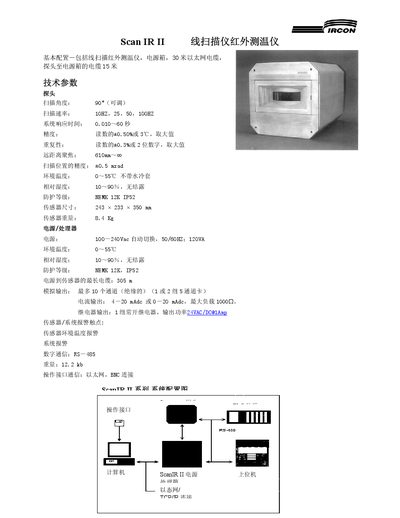
The ScanIR II is a line‑scan infrared thermometer designed for industrial temperature measurement in applications such as glass production and cement kilns. It consists of a sensor head, power/processor box, Ethernet cable and optional probe cables.
The document lists the basic configuration, technical specifications, model options, power and communication interfaces, and shows a system configuration diagram. It includes data on scanning angle, speed, accuracy, environmental limits, power supply, output channels and RS‑485 digital communication. This manual is written in Chinese.
| Scanning angle | 90° (adjustable) |
|---|---|
| Scanning speed | 10 Hz, 25 Hz, 50 Hz, 100 Hz |
| System response time | 0.010–60 s |
| Accuracy | ±0.50 % or ±3 °C (whichever is larger) |
| Repeatability | ±0.3 % or ±2 digits (whichever is larger) |
| Far‑distance focus range | 610 mm to ∞ |
| Sensor dimensions | 243 × 233 × 350 mm |
| Sensor weight | 8.4 kg |
| Power supply | 100‑240 VAC, auto‑switching, 50/60 Hz, 120 VA |
| Maximum cable length to sensor | 305 m |
| Analog output channels | up to 10 isolated channels |
| Current output | 4‑20 mA dc or 0‑20 mA dc, max load 1000 Ω |
| Relay output | 1 NO relay, 24 VAC/DC @ 1 A |
| Digital communication | RS‑485 |
| Network interfaces | Ethernet, BNC |
The ScanIR II provides a 90° scanning angle, which can be adjusted.
It operates from a 100‑240 VAC auto‑switching power supply at 50/60 Hz, rated at 120 VA.
Temperature readings are accurate to ±0.50 % or ±3 °C, whichever is larger.