
The Intersil ISL39300A-DAPDK is a dual‑band 54 Mbps Wi‑Fi access point with Linux OS, PoE, and extensive security features.
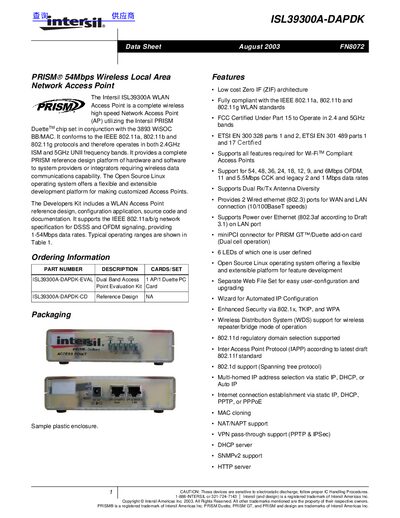
The ISL39300A‑DAPDK is a complete wireless high‑speed network access point that supports IEEE 802.11a/b/g standards in both 2.4 GHz ISM and 5 GHz UNII bands. It combines the Intersil PRISM Duette chipset with a 3893 WiSOC BB/MAC and runs an Open Source Linux platform for flexible customization.
Key hardware features include two 10/100 Base‑T Ethernet ports, Power over Ethernet (802.3af), dual Rx/Tx antenna diversity, a mini‑PCI connector for add‑on cards, six LEDs, and built‑in support for advanced security (802.1x, TKIP, WPA) and wireless distribution (WDS).
| Supported data rates | 1‑54 Mbps |
|---|---|
| Frequency bands | 2.4 GHz ISM and 5 GHz UNII |
| Ethernet ports | 2 × 10/100 Base‑T WAN/LAN ports |
| Power over Ethernet | 802.3af (Draft 3.1) |
| Antenna diversity | Dual Rx/Tx |
| LED indicators | 6 LEDs (one user‑defined) |
| Operating system | Open Source Linux |
| Security protocols | 802.1x, TKIP, WPA |
It conforms to IEEE 802.11a, 802.11b and 802.11g protocols.
Yes, it supports PoE according to 802.3af (Draft 3.1) on the LAN port.
The device includes two 10/100 Base‑T Ethernet ports for WAN and LAN connections.
It runs an Open Source Linux operating system.