
IBM brief on running Microsoft Hyper-V with Windows Server 2008 failover clusters on DS5000 storage, System x servers and BladeCenter.
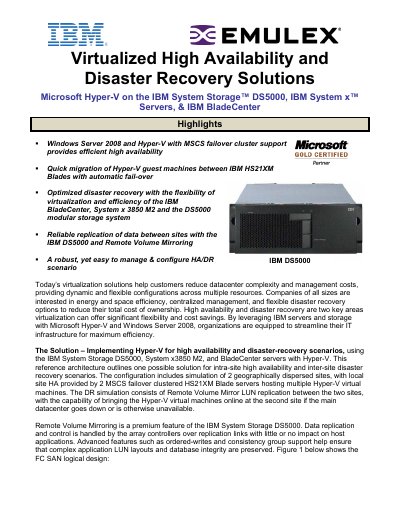
This document is an IBM reference architecture for intra-site high availability and inter-site disaster recovery using Microsoft Hyper-V on Windows Server 2008 with the IBM System Storage DS5000, IBM System x3850 M2 and BladeCenter servers. The configuration simulates two geographically dispersed sites: local high availability is provided by two MSCS failover clustered HS21XM blade servers hosting multiple Hyper-V virtual machines, while disaster recovery uses Remote Volume Mirroring LUN replication between the two sites so the virtual machines can be brought online at the second site.
The text walks through localized server failure, primary site failure and secondary site failure scenarios with accompanying figures, and lists key features of Hyper-V, the DS5000 storage system, the System x3850 M2 and x3950 M2 servers, the BladeCenter H chassis, and the Emulex LightPulse IBM-qualified Fibre Channel HBAs. It closes by noting that a full solution whitepaper will be available on the IBM ISV Solution website.
| DS5000 host interfaces | 8 Gb/s Fibre Channel and 10 Gb/s iSCSI ready |
|---|---|
| DS5000 drive interfaces | Sixteen 4 Gb/s Fibre Channel drive interfaces, support for up to 256 drives in initial release |
| DS5000 data cache | Up to 16 GB dedicated data cache (8 GB per controller) in initial release |
| DS5000 RAID support | RAID 6, 5, 3, 10, 1, 0 |
| DS5000 performance levels | Base model DS5100, high model DS5300 |
| System x3850 M2 / x3950 M2 memory | Up to 1TB of registered DIMM memory |
| BladeCenter H chassis capacity | 9U chassis with up to 14 blade servers, 10 switch modules and four power supplies |
It replicates LUNs between the primary and secondary sites so that Hyper-V virtual machines can be brought online at the second site if the main datacenter goes down.
The Hyper-V guest machines are restarted at the secondary site, replicated data is in a crash-consistent state, and application recovery methods such as log replay are activated.
No, the document states that Remote Volume Mirroring is a premium feature of the IBM System Storage DS5000.
Two MSCS failover clustered HS21XM blade servers host multiple Hyper-V virtual machines, with a System x3850 M2 at the secondary site.