
The Hitron HDG‑T3x2 Series HD Plastic DOME CAMERA manual provides safety instructions, installation steps, operation guidance, and technical specifications.
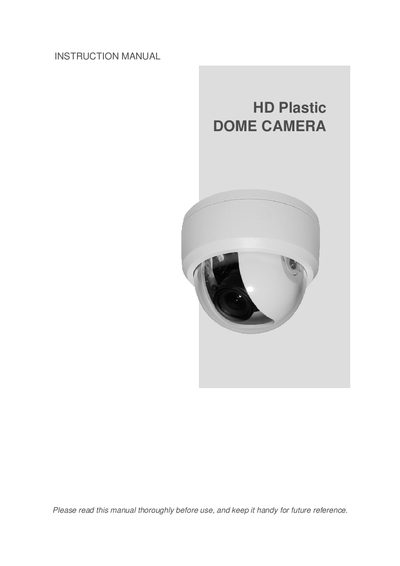
This manual covers safety precautions such as keeping the camera away from rain, moisture, and blocking ventilation, as well as proper handling, cleaning, and power‑off procedures. Detailed installation instructions include network cabling, PoE power connection, and mounting guidelines, followed by operation procedures for accessing the camera via a web browser, configuring video settings, and managing user accounts.
The document also lists the camera’s technical specifications, including sensor type, lens range, resolution options, frame rate, power consumption, and environmental limits, and provides preventive maintenance recommendations and troubleshooting tips.
| Image sensor | 1/2.7” Progressive scan RGB CMOS Active Array |
|---|---|
| Lens | Varifocal 3.0mm ~ 9.0mm, F1.2, DC IRIS |
| Angle of view | 3.0mm – 93° (H) / 9.0mm – 31.7° (H) |
| Camera angle adjustment | Pan 360°, Tilt 180°, Rotation 360° |
| Minimum illumination (color) | 2.5 Lux |
| Video compression | Motion JPEG, MPEG‑4 Part2, H.264 (MPEG‑4 Part 10) |
| Maximum resolution | 1920×1080 (HDG‑T322) |
| Frame rate | 30 fps at all resolutions |
| Power consumption | DC12V/PoE 330 mA (4.0 W) |
| Operating temperature | 0 °C ~ 50 °C |
The camera can be powered either by a DC12 V supply drawing 330 mA (4 W) or via Power over Ethernet (IEEE 802.3af).
The HDG‑T322 model supports up to 1920×1080 resolution, while the HDG‑T302 and HDG‑T312 support lower maximum resolutions.
Preventive maintenance should be carried out every three months, including inspection of cables, cleaning of components, and verification of mounting hardware.