
The Haoyu HYM1307 is a low-power I2C real-time clock chip with 56 bytes of non-volatile SRAM and a 32.768 kHz crystal oscillator.
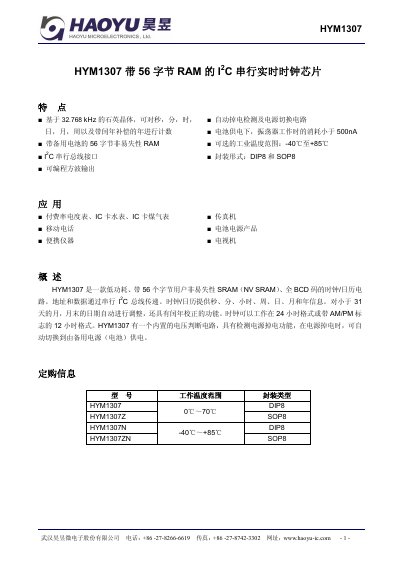
The Haoyu HYM1307 is a low-power, full BCD real-time clock/calendar circuit with 56 bytes of user non-volatile SRAM. It communicates over an I2C serial bus and uses a 32.768 kHz quartz crystal to count seconds, minutes, hours, day, month, week, and year with leap-year compensation.
The device supports 24-hour or 12-hour AM/PM format, automatic power-fail detection, and battery backup switching. It provides a programmable square-wave output at 1 Hz, 4.096 kHz, 8.192 kHz, or 32.768 kHz, consumes less than 500 nA on battery, and is offered in DIP8 and SOP8 packages with an optional industrial temperature range of -40°C to +85°C. This manual is written in Chinese.
| Interface | I2C serial bus |
|---|---|
| Crystal frequency | 32.768 kHz |
| User SRAM | 56 bytes |
| Battery current | < 500 nA |
| Package | DIP8 and SOP8 |
It uses an I2C serial bus interface.
The battery voltage must be kept between 2.0 V and 3.5 V for normal operation.
It is available in DIP8 and SOP8 packages.
The output can be 1 Hz, 4.096 kHz, 8.192 kHz, or 32.768 kHz.