
User manual with installation, operation, maintenance, safety and specifications for the ST51A, ST75A and ST75AV mass flow meters.
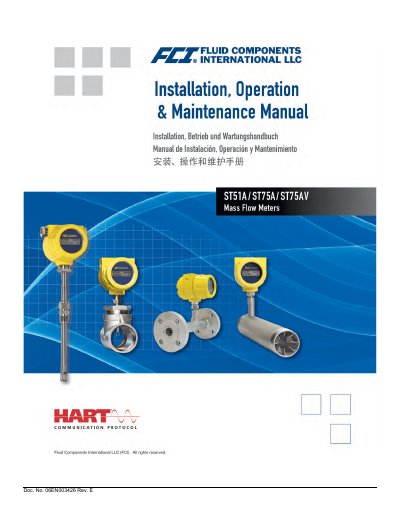
The ST51A, ST75A and ST75AV are thermal‑dispersion mass flow meters for air and gas applications. The ST51A is an insertion type for 2"‑24" lines, the ST75A is an in‑line type for ¼"‑2" lines, and the ST75AV uses a Vortab in‑line element. All models provide mass flow, totalized flow and temperature readings via dual 4‑20 mA, pulse, HART and optional LCD display.
The manual covers safety instructions, wiring, installation of flow elements and remote enclosures, configuration of HART and Modbus communication, calibration, troubleshooting, and warranty information. Detailed tables list optional accessories, specifications, and wiring diagrams.
| Media Compatibility (ST51A) | Air, compressed air, nitrogen |
|---|---|
| Pipe/Line Size Compatibility (ST51A) | 2" to 24" |
| Flow Range (ST51A) | 0.3 SFPS to 400 SFPS |
| Repeatability | ±0.5 % of reading |
| Temperature Compensation (Standard) | 40 °F to 100 °F |
| Maximum Operating Pressure (ST51A stainless steel ferrule) | 500 PSIG |
| Material of Construction (ST51A) | 316L stainless steel body |
The ST51A operates from 0 °F (‑18 °C) up to 350 °F (177 °C).
Installation must be performed by qualified personnel, follow NEC/CEC wiring rules, use a circuit breaker or disconnect switch, and observe ESD precautions.