
EXFO OTDR summary chart comparing models by applications, optical specifications, peripherals, features and platforms.
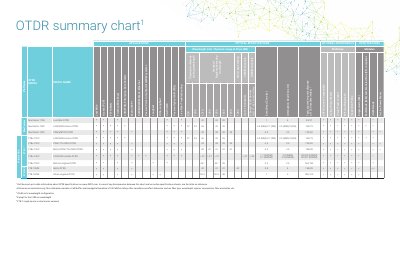
This one-page chart compares EXFO OTDR models across applications, optical specifications, optional peripherals, OTDR features and platforms. It lists wavelengths, dynamic range, dead zones, typical point-to-point distances and supported options for each model.
Distances are estimates only and depend on fiber type, wavelength, splices, connections and fiber anomalies. The chart notes that the most up-to-date OTDR specifications are available on www.EXFO.com.
| C-band channels | Up to 18 channels, 1528/1564 nm (ITU 17-62), 100/50 GHz |
|---|---|
| Event dead zone | 0.5 m (MM) / 0.7 m (SM) |
| Attenuation dead zone | 2.5 m (MM) / 3 m (SM) |
| Typical point-to-point distance at 1550 nm | 180/112 km/miles |
| Dynamic range at 20 μs | 50.5 dB |
It compares OTDR models by applications, optical specifications, optional peripherals, OTDR features and platforms.
No, distances are estimates only, based on a 5 dB buffer and 0.25 dB/km averaged attenuation.
On www.EXFO.com.
Fiber type, wavelength, splices, connections and fiber anomalies.