
Safety data sheet for Drago Wrap Vapor Intrusion Barrier, a polymer film barrier for vapor and water vapor under slabs.
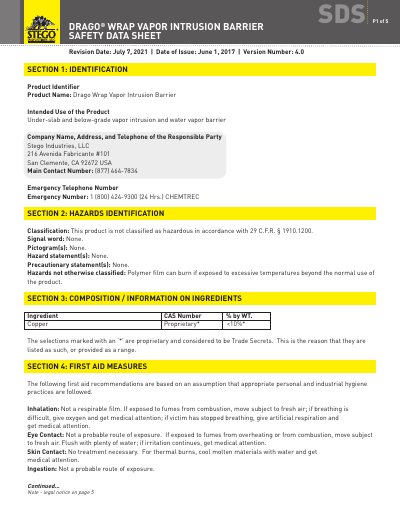
This Safety Data Sheet (SDS) provides hazard information and handling guidelines for Drago Wrap Vapor Intrusion Barrier, a polymer film used as a vapor and water vapor barrier under slabs and below grade. It details composition, first aid, fire-fighting, storage, and disposal instructions. The product is not classified as hazardous under 29 C.F.R. § 1910.1200, but precautions are advised for thermal burns and combustion fumes.
The material is stable under normal conditions, with decomposition temperature over 325°C. It is insoluble in water and not expected to cause environmental harm under normal use, though compatibility with certain chemicals may affect performance.
| Decomposition Temperature | >325°C (617°F) |
|---|---|
| Copper Content | <10%* |
| Storage Conditions | Cool, dry storage recommended. Indoor storage recommended. |
| Installation Temperature Range | Below 110°F (ambient) |
| In-Service Temperature Range | Below 85°F (soil and slab temperature, beginning 28 days following slab placement) |
No, this product is not classified as hazardous under 29 C.F.R. § 1910.1200.
The decomposition temperature is greater than 325°C (617°F).
Yes, if reclaiming is not feasible, dispose of as ordinary solid waste in compliance with local regulations.