
Crown engineering guide explaining constant-voltage (70V/100V) audio distribution, transformer selection, installation, and precautions.
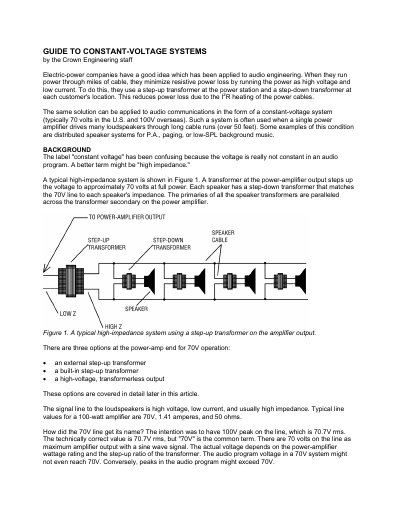
This guide was written by the Crown Engineering staff. It explains how constant-voltage systems apply the high-voltage, low-current approach to audio distribution, typically at 70 volts in the U.S. and 100V overseas, and when a single power amplifier drives many loudspeakers over long cable runs.
The document covers the background of 70V operation, advantages and disadvantages, speaker transformer taps, installation and impedance matching, precautions, and power-amplifier options. It also mentions Crown accessories including the TP-170V and T-170V autoformers and high-pass filter settings on CTs and CH amplifiers.
| Typical constant-voltage line | 70 V in the U.S.; 100 V overseas |
|---|---|
| Typical line values for a 100-watt amplifier | 70 V, 1.41 A, 50 ohms |
| Nominal 70V line voltage | 70.7 V rms |
| 200V system cable length | exceeding one mile |
| CTs high-pass filter settings | 70 Hz, 35 Hz, or bypass |
| CH high-impedance mode high-pass filter | 70 Hz |
| TP-170V | panel with four built-in autoformers |
| T-170V | single autoformer |
It is often used when a single power amplifier drives many loudspeakers through long cable runs over 50 feet, such as P.A., paging, or low-SPL background music.
The intention was to have 100V peak on the line, which is 70.7V rms; “70V” is the common term.
It must not exceed the amplifier's wattage rating.
The power amplifier will be loaded down and may overheat or distort.