
Technical overview of Cooper Bussmann high‑speed fuses, specifications, and application guidance for semiconductor protection.
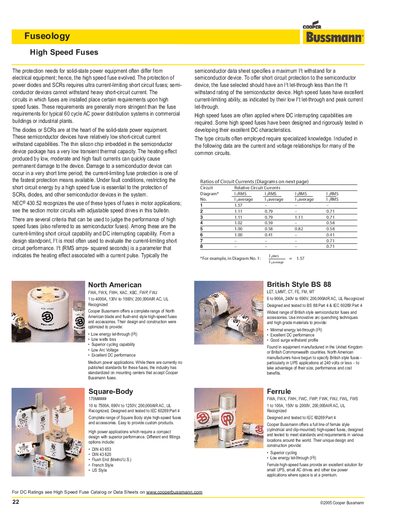
This leaflet describes Cooper Bussmann high‑speed fuses used to protect solid‑state power equipment such as diodes, SCRs, and IGBTs. It explains the need for ultra‑current‑limiting protection, the I²t let‑through concept, and the advantages of high‑speed fuses over conventional branch‑circuit devices.
The document lists the available fuse series (Square‑Body, British Style, Ferrule, North American, and the DFJ Drive Fuse), their current and voltage ratings, UL recognition, and IEC 60269 compliance. It also covers NEC 430.52 allowances, typical circuit configurations, and performance comparisons with standard Class J fuses.
| Square‑Body 170M current rating | 10 to 7500 A |
|---|---|
| Square‑Body 170M voltage rating | 690 V to 1250 V |
| British Style BS 88 current rating | 6 to 900 A |
| British Style BS 88 voltage rating | 240 V to 690 V |
| Ferrule series current rating | 1 to 100 A |
| Ferrule series voltage rating | 150 V to 2000 V |
| North American series current rating | 1 to 4000 A |
| North American series voltage rating | 130 V to 1000 V |
| UL recognition | UL Recognized |
| IEC 60269 compliance | Designed and tested to IEC 60269:Part 4 |
Semiconductor devices such as diodes and SCRs have low short‑circuit current withstand capability, so ultra current‑limiting fuses are required to limit fault energy and prevent permanent damage.