
French product leaflet for Boston Scientific Jagwire M005 Series high-performance guidewires, with features and a reference table of sizes and tip types.
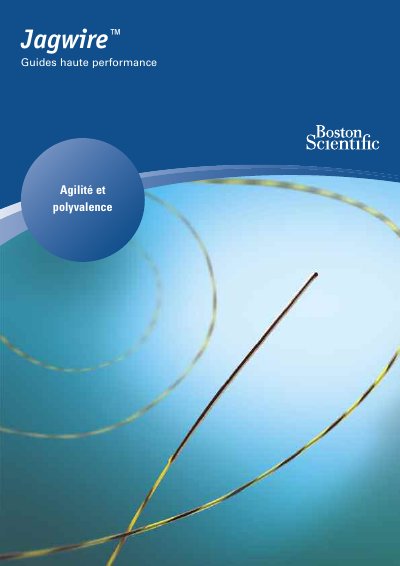
This leaflet presents the Jagwire high-performance guidewire range from Boston Scientific for biliary endoscopy (CPRE). It describes the tungsten-composed tip for fluoroscopic visualization and biliary access, the Endoglide coating on the distal section, the kink-resistant body, the 5 cm hydrophilic distal portion, the anti-slip proximal surface and the black-and-yellow pattern that allows clear endoscopic visualization. The guidewire can be locked in an intraluminal position during CPRE for safer access and simplified instrument exchange, and its insulated coating allows it to be left in place during sphincterotomy.
The second page contains the reference table of Jagwire M005 models, listing outer diameter in inches and millimeters, body type (standard, rigid body, extendable), tip taper, length (450 cm, 260 cm and 200 cm for the Jagtail RX model) and tip type (straight or curved). A warning states that the device may only be sold on medical prescription and that indications, contraindications, warnings and instructions are given in the notice supplied with each device. Clinical images are credited to Adam Slivka, M.D., Ph.D., University of Pittsburgh. This manual is written in French.
| Tip material | Tungsten-composed tip for fluoroscopic visualization and biliary access |
|---|---|
| Distal hydrophilic section | 5 cm |
| Distal coating | Endoglide coating for smooth progression |
| Proximal surface | Anti-slip surface requiring no special handling precautions, for precise torque control |
| Visualization pattern | Black and yellow pattern for clear endoscopic visualization |
| Tip taper (0.035 in models) | 0.035 to 0.027 in (0.89 to 0.69 mm) |
| Guidewire lengths | 450 cm and 260 cm; 200 cm for the Jagtail RX model |
The special tungsten-composed tip is used for fluoroscopic visualization and for access to the biliary duct.
Yes, the Jagwire can be locked in an intraluminal position during CPRE for safer access and simplified instrument exchange.
The hydrophilic distal section is 5 cm long and facilitates selective catheterization and negotiation of tortuous anatomy.
Yes, thanks to its insulated coating the guidewire can be left in place during sphincterotomy.