
Technical data sheet for ATI 15Mo™ titanium alloy covering composition, properties, heat treatment, and specifications.
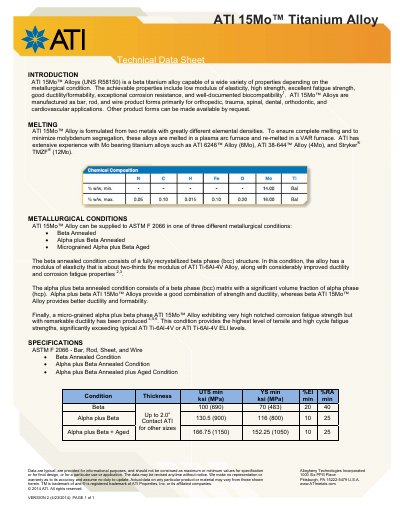
The ATI 15Mo™ titanium alloy is a beta‑type alloy designed for orthopedic, trauma, spinal, dental, orthodontic, and cardiovascular applications. It can be supplied in bar, rod, and wire forms and is available in three metallurgical conditions: beta annealed, alpha‑plus‑beta annealed, and micro‑grained alpha‑plus‑beta aged.
The sheet provides physical properties such as melting range, density, and elastic modulus, detailed heat‑treatment procedures, mechanical specifications, machinability guidance, and corrosion‑resistance information for use in medical implant design and manufacturing.
| Melting Range | 3,100 – 3,200 °F (1,704 – 1,760 °C) |
|---|---|
| Density | 0.179 lb/cu in. (4.95 g/cc) |
| Beta Transus Temperature | 1,425 °F (± 25 °F) / 774 °C (± 14 °C) |
| Elastic Modulus (beta annealed) | 78 GPa |
| Elastic Modulus (alpha‑plus‑beta annealed) | 106 GPa |
| Elastic Modulus (micro‑grained aged) | 114 GPa |
The alloy melts between 3,100 °F and 3,200 °F (1,704 °C – 1,760 °C).
Rapid cooling after annealing (beta annealed condition) or slow cooling (alpha/beta condition) is required to prevent ω embrittlement.
Anneal at 1,475 – 1,800 °F (802 – 982 °C) for 0.5‑1 hour, then rapid quench below 1,025 °F (552 °C).