The package insert for SiLiBa Levodopa Tablets by Aikang Lide Pharmaceutical provides dosage, indications, contraindications, side effects, and storage…
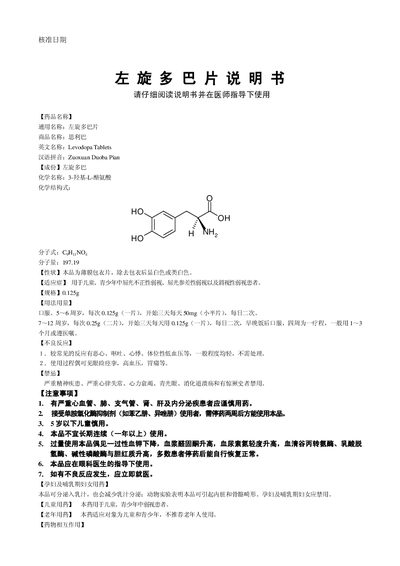
SiLiBa Levodopa Tablets are film‑coated tablets containing the active ingredient levodopa, used to treat refractive amblyopia in children and adolescents. The tablets appear white or off‑white after the coating is removed and are supplied in 0.125 g strength.
The insert details oral dosing regimens for different age groups, lists common adverse reactions such as nausea and orthostatic hypotension, outlines contraindications (e.g., severe cardiovascular disease, glaucoma), and provides precautions, drug‑interaction warnings, and overdose management steps. Storage instructions, packaging details, and regulatory information are also included. This manual is written in Chinese.
| Active ingredient | Levodopa |
|---|---|
| Dosage form | Film‑coated tablet |
| Strength | 0.125 g per tablet |
| Molecular formula | C9H11NO4 |
| Molecular weight | 197.19 g·mol⁻¹ |
The recommended dose is 0.125 g (one tablet) taken twice daily, starting with 50 mg (half a tablet) for the first three days.
Common adverse reactions include nausea, vomiting, palpitations, and orthostatic hypotension.
No, the medication is contraindicated for pregnant and breastfeeding women because it can be secreted in milk and cause fetal abnormalities.
Immediate vomiting, gastric lavage, measures to increase elimination, and supportive therapy according to the patient’s condition are recommended.