
Instructions for handling, storage, and application of the BCECF, AM pH probe (product codes C028/C029).
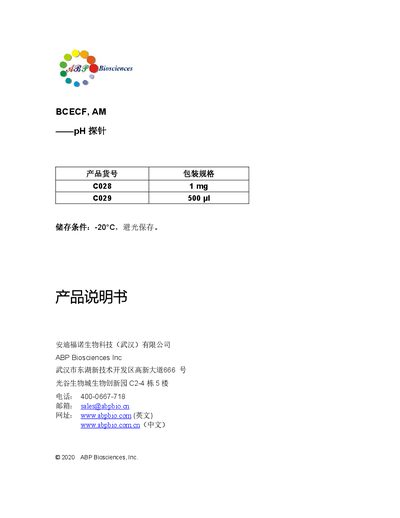
This manual provides detailed information on the BCECF, AM fluorescent pH probe, including its chemical properties, recommended storage conditions, and preparation of stock solutions. It also describes protocols for staining mammalian cells, tissue samples, bacteria, yeast, and plant protoplasts, as well as methods for pH calibration and functional assays.
Safety precautions, recommended excitation/emission settings, and troubleshooting tips are included to ensure reliable fluorescence measurements in various biological experiments. This manual is written in Chinese.
| Packaging (C028) | 1 mg |
|---|---|
| Storage condition | -20°C, protect from light |
| pKa | 7.0 |
| Maximum excitation wavelength | ≈503 nm |
| Maximum emission wavelength | ≈520 nm |
| Recommended excitation wavelength | 488 nm |
| Recommended emission wavelength | 535 nm |
| Working solution concentration | 1–10 μM |
Store the probe at –20 °C in a dry, light‑protected environment; under these conditions it remains stable for at least six months.
The recommended excitation wavelength is 488 nm, with emission detection at 535 nm.
A working concentration of 1–10 μM is commonly used; concentrations as low as 0.1 μM can also give good staining results.
BCECF has a pKa of about 7.0, which matches the normal cytoplasmic pH range (≈6.8–7.4), making it ideal for measuring intracellular pH.