
The LTC4223 is a dual supply hot swap controller designed for Advanced Mezzanine Cards (AMC). It controls the main 12V supply using an external N-channel MOSFET and the 3.3V auxiliary supply with an integrated switch. The 12V output ramp rate is adjustable and includes inrush current limiting. The 12V output is protected against short circuit faults with a fast acting current limit and a 5% accurate timed circuit breaker. The 3.3V output features soft start and overcurrent protection. The LTC4223 provides a current monitor output for the 12V supply and reports fault and power-good status for both supplies. It also detects card presence and allows independent control of the 12V and 3.3V outputs. The LTC4223-1 features a latch-off circuit breaker, while the LTC4223-2 provides automatic retry after a fault.
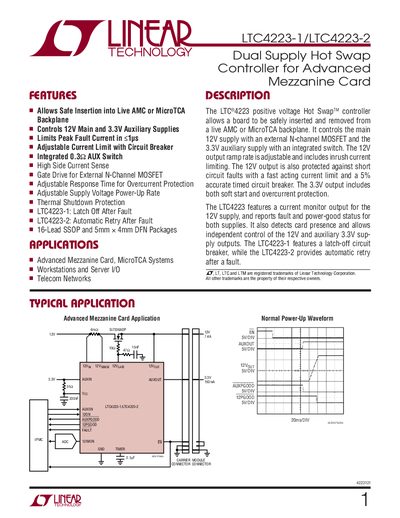
The LTC4223‑1/LTC4223‑2 is a dual‑supply hot‑swap controller designed for Advanced Mezzanine Card (AMC) and MicroTCA backplanes. It manages a 12 V main supply and a 3.3 V auxiliary supply, providing in‑rush current limiting, short‑circuit protection, adjustable current limit, and thermal shutdown. The LTC4223‑1 version includes a latch‑off circuit breaker, while the LTC4223‑2 version adds automatic retry after a fault.
The document provides absolute maximum ratings, electrical characteristics, pin descriptions, functional diagrams, and typical performance curves. It also includes package information for SSOP and DFN variants and outlines the turn‑on sequence and operation of the internal circuitry.
| 12V IN supply voltage range | –0.3 V to 20 V |
|---|---|
| AUXIN supply voltage range | –0.3 V to 10 V |
| VCC supply voltage range | –0.3 V to 7 V |
| Operating temperature range (C‑type packages) | 0 °C to 70 °C |
The LTC4223‑1 includes a latch‑off circuit breaker, while the LTC4223‑2 provides automatic retry after a fault.
A rising edge on the 12ON pin turns on the external N‑channel MOSFET that drives the 12 V supply.
The TIMER pin, together with a capacitor to ground, sets timing durations for power‑up and current‑limit cycles.