
Instruction sheet for the 3B Scientific R 1024633 Fine Beam Tube covering safety, setup, operation, and electron charge-to-mass measurement experiments.
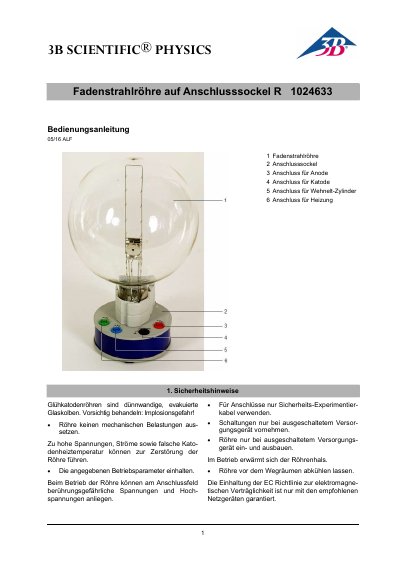
The 3B Scientific R 1024633 Fine Beam Tube is a physics demonstration apparatus used to investigate the deflection of cathode rays in a uniform magnetic field and to quantitatively determine the specific charge of the electron (e/m). The tube contains an electron gun with an indirectly heated oxide cathode, a Wehnelt cylinder, and a perforated anode in a neon gas atmosphere at low pressure, producing a sharp, luminescent electron beam.
The tube is mounted on a connection base with colored terminals and a built-in protective circuit that limits voltage to the cut-off value, preventing heater damage and ensuring smooth voltage ramp-up. The manual provides safety warnings, technical specifications, required equipment (Helmholtz coil pair and DC power supplies), step-by-step setup and beam adjustment procedures, and an experiment example for measuring e/m by plotting the beam radius against accelerating voltage and magnetic field. This manual is written in German.
| Gas filling | Neon |
|---|---|
| Gas pressure | 1.3 x 10^-5 bar |
| Filament voltage | 5 to 7 V DC |
| Filament current | < 350 mA |
| Anode voltage | 200 to 300 V |
| Anode current | < 3 mA |
| Diameter of fine beam path | 20 to 120 mm |
| Division spacing | 20 mm |
| Tube diameter | 160 mm |
| Total height incl. base | 260 mm |
| Base plate dimensions | 115 x 115 x 35 mm |
| Weight | approx. 820 g |
The tube is filled with neon at a pressure of 1.3 x 10^-5 bar.
The filament voltage should be between 5 and 7 V DC, as indicated by the cut-off voltage on the tube socket.
It shuts off any voltage exceeding the preset cut-off voltage to protect the heater filament and ensures a smooth voltage ramp-up when switched on.
By measuring the radius of the electron beam's circular path in a magnetic field for different accelerating voltages and plotting r²B² against 2U; the slope of the resulting straight line through the origin gives e/m.