
The 4A Biotech Cell Counting Kit‑8 (FXP132) technical data sheet describes its principle, usage, storage conditions and FAQs for cell proliferation and…
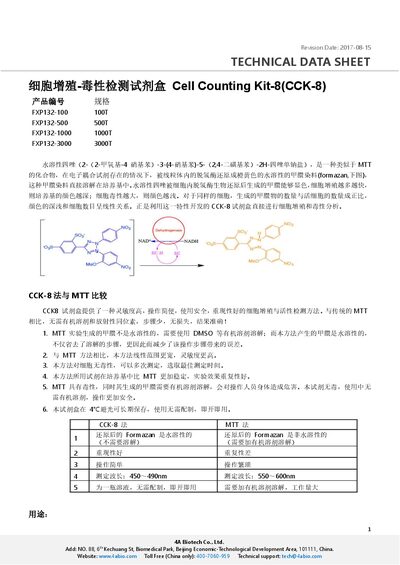
The Cell Counting Kit‑8 (CCK‑8) is a water‑soluble tetrazolium salt that is reduced by mitochondrial dehydrogenases in viable cells to a yellow formazan dye. The intensity of the color is proportional to the number of living cells, allowing quantification of cell viability and proliferation.
The sheet provides detailed instructions for preparing standard curves, performing cell viability and toxicity assays in 96‑well plates, storage guidelines (0‑5 °C for one year, –20 °C for two years), and a comprehensive FAQ that addresses common experimental issues such as reference wavelength settings, blank controls, and interference from reagents.
| Model numbers | FXP132‑100, FXP132‑500, FXP132‑1000, FXP132‑3000 |
|---|---|
| Detection wavelength | 450–490 nm |
| Storage temperature and shelf life | 0‑5 °C for 1 year; –20 °C for 2 years (protected from light) |
| Formazan solubility | Water‑soluble (no organic solvent required) |
It is not required; the CCK‑8 reagent has no absorbance at the reference wavelength, but setting one can help remove background from turbid samples.
Use wells that contain culture medium and CCK‑8 but no cells; if a drug is present, include the drug in the blank as well.
Add CCK‑8 at a volume equal to one‑tenth of the culture medium volume in each well.