
TetraCon 325 is a conductivity measuring cell for on-site measurement of conductivity in rivers, lakes and waste water. It is also suitable for fish farming, ground water measurements and applications in water laboratories.
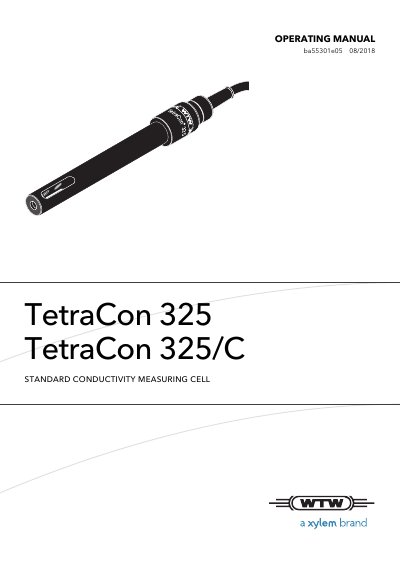
This operating manual (ba55301e05, 08/2018) covers the TetraCon 325 and TetraCon 325/C standard conductivity measuring cells from Xylem Analytics. It describes the structure of the cell - voltage electrodes, current electrodes, a temperature sensor in a graphite enclosure, shaft and closing head - and lists the recommended fields of application, including on-site measurements in rivers, lakes and wastewater, fish farming, ground water measurements and water laboratories. The TetraCon 325/C is described as especially suitable for higher chemical loads, particularly acidic media.
The manual explains outside cleaning and the cleaning procedure for lime sediments and fat/oil contamination, notes that the cell normally does not age but can be damaged by strong acids and bases, organic solvents or excessive temperatures, and recommends disposal as electronic waste. A troubleshooting table lists error symptoms, causes and remedies, and the technical data section gives the measuring principle, cell constant, temperature sensor, materials, cable lengths, plug type, pressure resistance, pin assignment, measurement, storage and immersion conditions.
| Measuring principle | Four-electrodes measurement |
|---|---|
| Cell constant | 0.475 cm -1 ±1.5 % |
| Temperature sensor | Integrated NTC 30 (30 k at 25 °C / 77 °F) |
| Weight | Approx. 135 g |
| Shaft material | Epoxy |
| Connection head material | POM (TetraCon 325), PEEK (TetraCon 325/C) |
| Conductivity electrodes | Graphite |
| Connection cable lengths | TetraCon 325: 1.5 / 3 / 6 / 10 / 15 / 20 m; TetraCon 325/C: 1.5 m |
| Cable diameter | 6 mm |
| Smallest allowed bend radius | 50 mm fixed installation, 80 mm flexible use |
| Plug type | Socket, 8 pins |
| Pressure resistance | IP 68 (2 x 10⁵ Pa or 2 bar); cable plug IP 67 when plugged in |
| Temperature range | -5 ... 80 °C (100 °C), 23 ... 176 °F (212 °F) |
| Minimum depth of immersion | 36 mm |
| Storage temperature | 0 ... 50 °C (32 ... 122 °F) |
| Precision of the temperature sensor | ± 0.2 K |
On-site measurements in rivers, lakes and wastewater, fish farming, ground water measurements and applications in water laboratories. The TetraCon 325/C is especially suitable for higher chemical loads, particularly acidic media.
Immerse the cell in acetic acid for 5 minutes, using a volume share of 10 %.
Check or correct the cell constant, make sure the correct sensor is being used for the application, clean the conductivity measuring cell, or return the sensor.
Normally the conductivity measuring cell does not age. Strong acids and bases, organic solvents or temperatures that are too high may considerably reduce its lifetime or lead to damage.
The recommended storing method is in air, at a storage temperature of 0 ... 50 °C (32 ... 122 °F).