
JTDZ drilling rod is a simple, fast and labor-saving drilling tool. It has a wide range of applications. Its main function is to verify the suspicious leak points detected by the leak detector to avoid unnecessary excavation due to other interference factors.
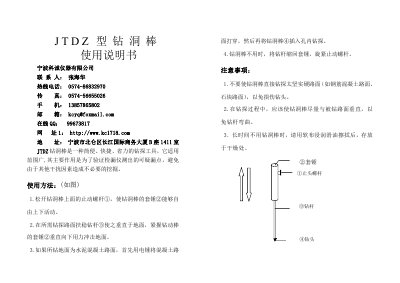
The Kecheng JTDZ drilling rod is a simple, fast, and labor-saving drilling tool with a wide application range. Its main purpose is to verify suspicious leak points detected by a leak detector, helping to avoid unnecessary excavation caused by other interference factors.
To operate, loosen the stop screw so the sleeve hammer can move freely, hold the drill rod perpendicular to the ground, and strike downward with the sleeve hammer. For cement concrete pavement, break through with an electric hammer first. After use, retract the drill rod into the sleeve hammer and tighten the stop screw; for long-term storage, wipe with an oil-dampened soft cloth and keep in a dry place. This manual is written in Chinese.
It verifies suspicious leak points found by a leak detector to avoid unnecessary excavation.
Wipe it with a soft cloth dipped in lubricating oil and store it in a dry place.
An electric hammer is used to break through the concrete first.
To keep the drill rod from bending.