
The invention discloses a glass magnesium, bamboo, wood and plant fiber composite board, which is composed of a glass magnesium bamboo, wood and plant fiber composite layer and a glass fiber mesh cloth layer or a bamboo woven mesh reinforcing layer. The characteristic is that the glass magnesium bamboo, wood and plant fiber composite layer has at least two layers, the glass fiber mesh cloth layer or the bamboo woven mesh reinforcing layer has at least one layer, and the two layers of glass magnesium bamboo, wood and plant fiber layers are placed below and above the glass fiber mesh cloth layer or the bamboo woven mesh reinforcing layer.
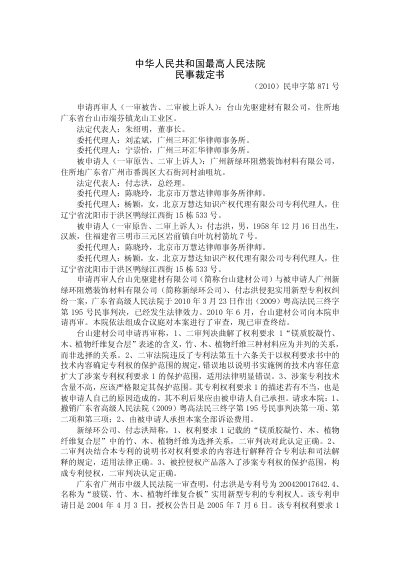
This document is a legal ruling (Civil Ruling No. 871 of 2010) issued by the Supreme People's Court of the People's Republic of China. It concerns a dispute between Taishan Xianqu Building Materials Co., Ltd. and Guangzhou Xinlvhuan Flame-Retardant Decoration Materials Co., Ltd. (along with individual Fu Zhihong) regarding patent infringement.
The case centers on the interpretation of a utility model patent (No. 200420017642.4) titled "Glass Magnesium, Bamboo, Wood, and Plant Fiber Composite Board." The court analyzed whether the accused product infringed the patent, specifically focusing on the claim that the composite layer must contain bamboo, wood, and plant fibers simultaneously versus the patent specification suggesting a choice among them. The court ultimately ruled that the patent claims take precedence over the specification's broader description, finding the accused product did not infringe because it lacked bamboo and wood components. This manual is written in Chinese.
The board is designed to have fireproof, moisture-proof, and water-resistant functions.
The purchased boards had thicknesses of 6mm, 8mm, and 10mm.