
The present invention discloses a distributed measurement system base station attitude compensation device, comprising a plurality of base stations and an optoelectronic self-collimator; wherein, the base station comprises an inclination sensor embedded in the base station and a reflector arranged on a side wall of the base station; the base station is placed on a precision swing platform; the mirror surface of the reflector substantially coincides with the YOZ plane of the inclination sensor coordinate system, and the normal vector of the mirror surface is substantially in the same direction as the positive direction of the X axis of the inclination sensor coordinate system, and the coordinate system of the optoelectronic self-collimator does not change with the change of the attitude of the inclination sensor and the mirror coordinate system; and the light source emission axis of the optoelectronic self-collimator is in a parallel state with the vertical line of the center of the reflector of the base station.
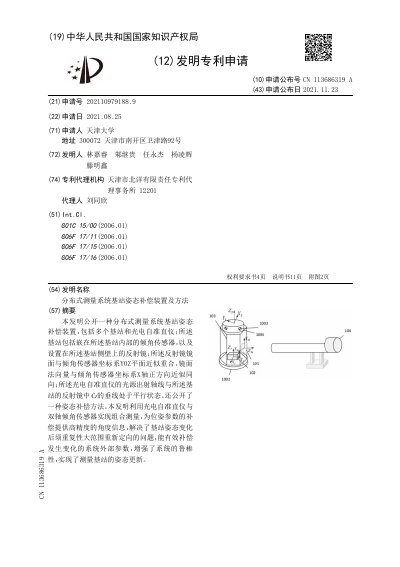
The document discloses an invention for a distributed measurement system base station attitude compensation device. The system comprises multiple base stations and photoelectric autocollimators. Each base station includes an embedded dual-axis tilt sensor and a reflector mounted on its side wall. The photoelectric autocollimator's light source axis is parallel to the vertical line of the reflector center.
The invention also discloses a corresponding attitude compensation method. This method utilizes the combination of the photoelectric autocollimator and the dual-axis tilt sensor to achieve high-precision angle measurement. It solves the problem of requiring repeated large-range re-orientation after the base station attitude changes, effectively compensating for changed external system parameters and enhancing system robustness. This manual is written in Chinese.
| Autocollimator angular measurement accuracy | 0.4" |
|---|---|
| Tilt sensor type | Dual-axis tilt sensor |
The base station includes an embedded dual-axis tilt sensor and a reflector mounted on its side wall.
It uses a combination of photoelectric autocollimators and dual-axis tilt sensors to provide high-precision angle information for compensation.