
The present invention discloses a synthetic process for an intermediate of a plant protection agent, which relates to the technical field of synthesis of nitrogen-containing heterocyclic compounds. The synthetic process comprises the following steps: dehydration condensation reaction of tert-butylurea and ethyl acetoacetate in the presence of a substituted aromatic hydrocarbon solvent and a phosphorus-containing catalyst to generate 3-(3-tert-butyl)urea-2-butenoate; and further cyclization reaction under alkaline conditions to obtain 3-tert-butyl-6-methyluracil. The present invention optimizes the catalyst and solvent for the dehydration condensation reaction, and significantly improves the yield and purity of 3-tert-butyl-6-methyluracil compared with the prior art, and has low production cost, stable and repeatable process, and meets the requirements of commercial production.
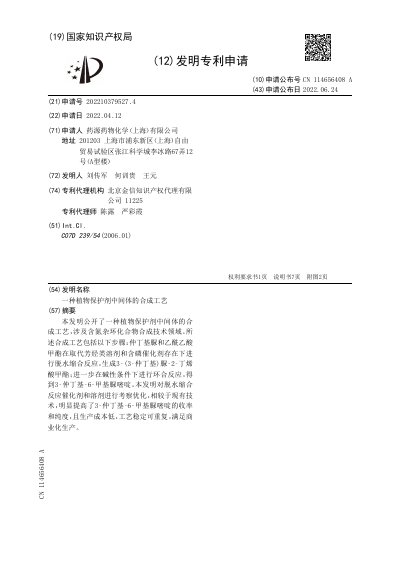
This document is a Chinese patent application for preparing 3-sec-butyl-6-methyl uracil, an intermediate for the plant protection agent 5-bromo-3-sec-butyl-6-methyl uracil. It describes a two-step process: dehydration condensation of sec-butyl urea with methyl acetoacetate, followed by cyclization under alkaline conditions.
The application compares prior synthetic routes and states that optimized phosphorus-containing catalysts and substituted aromatic solvents improve yield and purity while keeping costs low. It also provides reaction conditions, solvent and catalyst options, base choices, and purification steps. This manual is written in Chinese.
Phosphorus pentoxide, polyphosphoric acid, or phosphoric acid.
o-Xylene, m-xylene, p-xylene, or ethylbenzene.
The reaction temperature is 50-100 C, preferably 70-90 C, and the reaction time is 6-30 h.
Sodium methoxide or sodium hydride.