
The present invention discloses a magnetic resonance reconstruction method based on deep learning and data consistency, involving the field of magnetic resonance reconstruction methods; comprising 1: collecting K-space data and integrating it into a network composed of convolutional neural networks and data consistency layers in sequence to complete network construction; 2: converting the undersampled data in the K-space data into a folded image as the input of the constructed network, and converting the fully sampled data thereof into a complete image as the tagged data of the constructed network, and using the tagged data as a target to train the network through back propagation to obtain the mapping relationship between the network input and output; 3: inputting the corresponding image of the test set into the trained network for forward propagation to obtain the output image to complete the magnetic resonance reconstruction. The present invention solves the problems that the existing magnetic resonance reconstruction method based on deep learning does not make full use of the collected data and can only process single channels, resulting in poor reconstruction performance and stability, and achieves the effect of implementing supervision, improving learning ability and thus improving reconstruction performance.
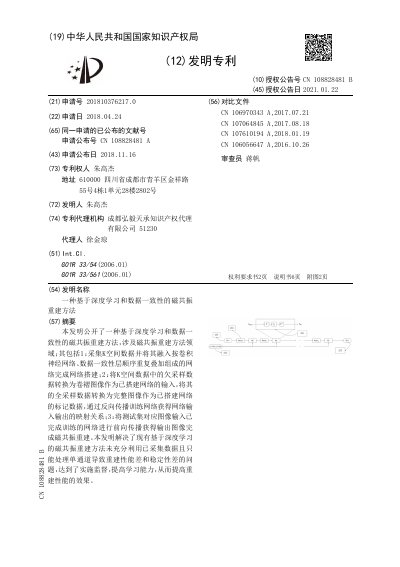
The document is a patent application (CN 108828481 B) filed by inventor Zhu Gaojie. It discloses a method for reconstructing magnetic resonance images by integrating K-space data into a convolutional neural network with data consistency layers. The method involves training the network using undersampled and fully sampled K-space data to learn a mapping relationship, which is then used to reconstruct images from test sets.
The text details the technical steps, including the use of multi-channel receiver coils, Fourier transforms to generate wrapped images, and the specific architecture of the neural network (convolutional layers, normalization layers, activation layers, etc.). It also describes the data consistency constraint process where the network output is transformed back to K-space and combined with the acquired data to ensure fidelity. This manual is written in Chinese.
Existing deep-learning magnetic resonance reconstruction methods do not fully use collected data and can only handle single-channel data, causing poor reconstruction performance and stability.
Collect K-space data and integrate it into a network built by repeatedly stacking a convolutional neural network and a data consistency layer.
It includes a convolution layer, normalization layer, activation layer, pooling layer, unpooling layer, and connection layer.
It is Nx*Ny*Nc, where Nx is the number of rows, Ny is the number of columns, and Nc is the number of receiving channels.