
This document is about nutrition and diet, it introduces the history of vitamins, the types of vitamins and the functions of vitamins.
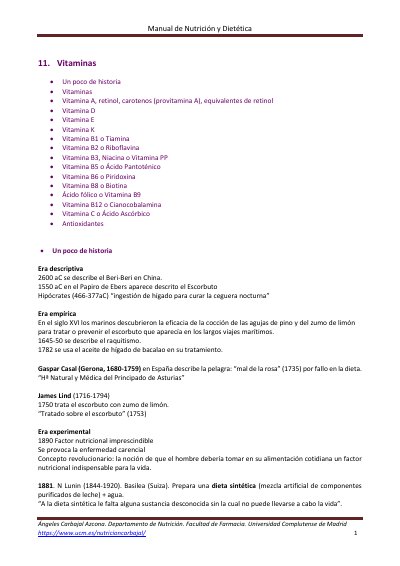
This Spanish-language manual, written by Ángeles Carbajal Azcona of the Departamento de Nutrición, Facultad de Farmacia, Universidad Complutense de Madrid, reviews the history of vitamin research from its descriptive and empirical beginnings — Beri-Beri described in China around 2600 BC, scurvy in the Ebers Papyrus, and James Lind's 1750 lemon-juice treatment — through the experimental era, when Lunin, Eijkman, Hopkins and Funk established the existence of vitamins and Funk coined the term "vitamina" in 1911.
The manual then defines vitamins as organic micronutrients without energy value that must be supplied by the diet in very small amounts to maintain health, and lists the thirteen described vitamins: A, D, E, K, the B group (B1, B2, B3, B5, B6, B8, B9, B12) and C. It notes which can be formed in the body (vitamin D in the skin by sun exposure, niacin from tryptophan, and K2, B1, B2 and biotin by intestinal bacteria), usually insufficiently, and relates deficiency diseases such as scurvy, pellagra, xerophthalmia, beri-beri, megaloblastic anemia and rickets. This manual is written in Spanish.
Casimir Funk, bioquímico polaco que trabajaba en el Instituto Pasteur de París, lo acuñó en 1911 al aislar un concentrado del agua usada para refinar el arroz que curaba la enfermedad.
No. Vitamins are organic micronutrients without energy value.
They have specific functions related to promoting and regulating processes needed for growth, reproduction, and maintaining health.
A vitamin A deficiency can cause blindness.