
Thoracic Spine Treatment: An Evidence-Based Approach Clinical EBP Example Application

This document describes a method for treating the thoracic spine, including spinal mobility analysis, joint mobilization, and soft tissue stretching.
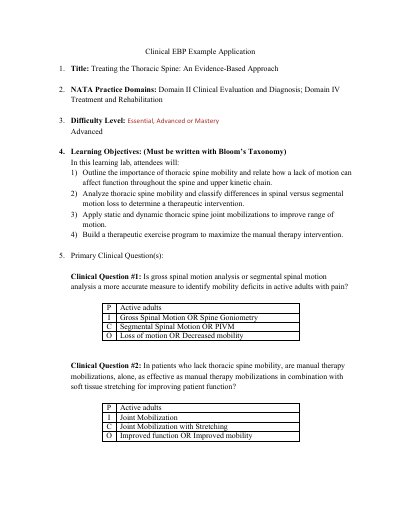

Thoracic Spine Treatment: An Evidence-Based Approach Clinical EBP Example Application - cover page
Document type
Other
Language
English
Pages
5
File format
PDF
File size
128 KB
Published
16 November, 2023
Updated
16 November, 2023
MD5 checksum
92778F2F3C33C9742D00AB3B756F06EB

About this manual

This document is a clinical evidence-based practice example application titled Treating the Thoracic Spine: An Evidence-Based Approach. It lists NATA practice domains, difficulty level, learning objectives, clinical questions, educational need, references, clinical bottom line, learning methods, and the instructor.

It addresses thoracic spine mobility, including global and segmental motion assessment, passive intervertebral motion assessment, joint mobilization, soft tissue stretching, and therapeutic exercise.

What's inside

  • Clinical EBP Example Application
  • NATA Practice Domains
  • Difficulty Level
  • Learning Objectives
  • Primary Clinical Questions
  • Educational Need and Practice Gap
  • Peer-Reviewed References
  • Clinical Bottom Line
  • Learning Methods
  • Instructors

Frequently asked questions

What difficulty level is listed for this program?

Advanced.

What learning methods will the program use?

A 1-hour lecture and a 1-hour lab.

Who is the listed instructor?

Dr. Scott Lawrance, DHSc, LAT, ATC.

What does the clinical bottom line recommend?

Athletic trainers should add passive intervertebral motion assessments and combine mobilizations with exercise.

Download PDF (128 KB)

Also Manuals