
This document describes the guidelines for pediatric trauma imaging.
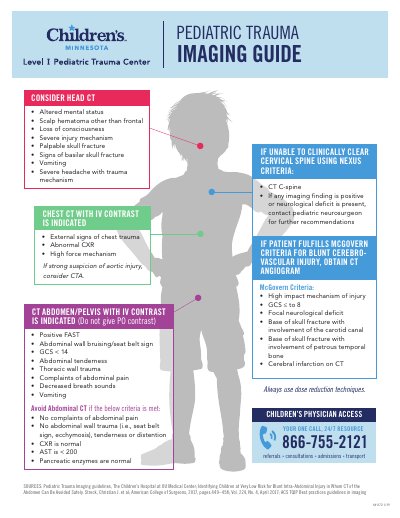
This one-page pediatric trauma imaging guide from The Children's Hospital at OU Medical Center sets out when CT studies with IV contrast are indicated for injured children, and when abdominal CT can be avoided. It covers CT of the abdomen/pelvis, chest, cervical spine and head, and notes the McGovern criteria for CT angiogram in blunt cerebrovascular injury.
The guide lists the findings that support each study, the criteria for avoiding abdominal CT (no abdominal pain, no abdominal wall trauma, normal CXR, AST under 200, normal pancreatic enzymes), and the instruction to always use dose reduction techniques. It closes with a 24/7 physician access line for referrals, consultations, admissions and transport.
Indications include a positive FAST, abdominal wall bruising or seat belt sign, GCS below 14, abdominal tenderness, thoracic wall trauma, complaints of abdominal pain, decreased breath sounds and vomiting. PO contrast should not be given.
When there are no complaints of abdominal pain, no abdominal wall trauma, tenderness or distention, a normal CXR, AST under 200 and normal pancreatic enzymes.
A CT C-spine is obtained. If any imaging finding is positive or a neurological deficit is present, the pediatric neurosurgeon is contacted for further recommendations.
Always use dose reduction techniques.