
This document is about the Violence Risk Appraisal Guide (VRAG) Sex Offender Risk Appraisal Guide (SORAG).
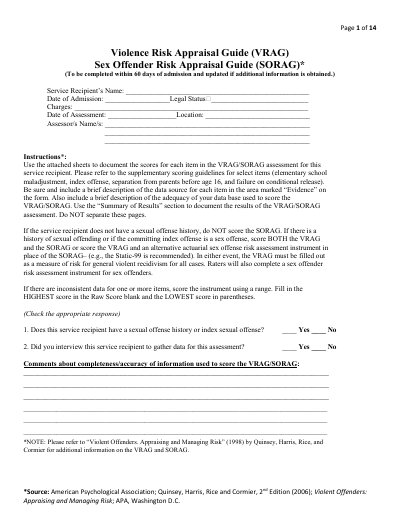
This form is the Violence Risk Appraisal Guide (VRAG) and Sex Offender Risk Appraisal Guide (SORAG) assessment instrument, sourced from the American Psychological Association publication by Quinsey, Harris, Rice and Cormier, 2nd Edition (2006). It is to be completed within 60 days of admission and updated if additional information is obtained, and it records service recipient details, assessor information, item scores, and evidence.
The form includes a Childhood and Adolescent Taxon Scale, a conduct disorder symptom checklist, VRAG items with scoring weights, Cormier-Lang criminal history scoring, and a Summary of Results section. It states that SORAG is not scored when there is no sexual offense history, VRAG is completed for all cases, and no risk category is specified for females.
It is to be completed within 60 days of admission and updated if additional information is obtained.
No. If the service recipient does not have a sexual offense history, do not score the SORAG.
Score the instrument using a range, filling the highest score in the Raw Score blank and the lowest score in parentheses.
No. For females, indicate N/A; research on the VRAG with women has not supported its predictive validity.