
Herbicide Reference Guide, introduces the use of herbicides and precautions.
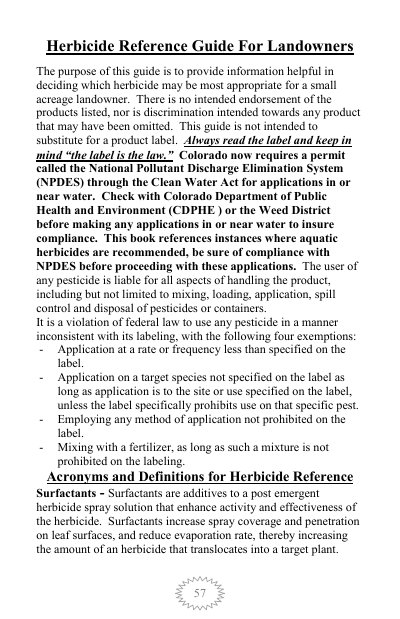
This guide is written to help a small acreage landowner decide which herbicide may be most appropriate. It states that no endorsement of the listed products is intended and that it is not a substitute for a product label; the label is described as the law. It notes that Colorado requires a National Pollutant Discharge Elimination System (NPDES) permit through the Clean Water Act for applications in or near water, and that the user of any pesticide is liable for all aspects of handling the product, including mixing, loading, application, spill control and disposal. It also lists four exemptions under which use inconsistent with labeling is not a violation.
The guide includes acronyms and definitions for herbicide reference, covering surfactants (COC, MSO and NIS) with their typical rates and the herbicides they are recommended with, along with GUP, MSDS, PPE, re-entry interval, RUP, signal words and toxicity. A herbicide index lists brand names with their active ingredients, remarks and page numbers, followed by sections on individual active ingredients such as aminocyclopyrachlor, aminopyralid and chlorsulfuron, giving signal words, rainfast and re-entry periods, use sites, environmental characteristics and primary target species.
It is an additive to a post emergent herbicide spray solution that enhances the activity and effectiveness of the herbicide, increasing spray coverage and penetration on leaf surfaces and reducing evaporation.
Yes. Colorado requires an NPDES permit through the Clean Water Act for applications in or near water; check with CDPHE or the Weed District before applying.
The guide says the best answer is to use the recommended surfactant designed to enhance the activity of a specific herbicide.
They indicate the toxicity and hazards associated with the pesticide: Caution is Category 3 or 4 and least toxic, Warning is Category 2, and Danger/Poison is Category 1 and most toxic.
It restricts the purchase of a product, and its uses, to a licensed commercial, private or public applicator; landowners can obtain a Private Applicator's License through the Colorado Department of Agriculture.