
This document describes how to use the CONOX consciousness and nociception monitor.
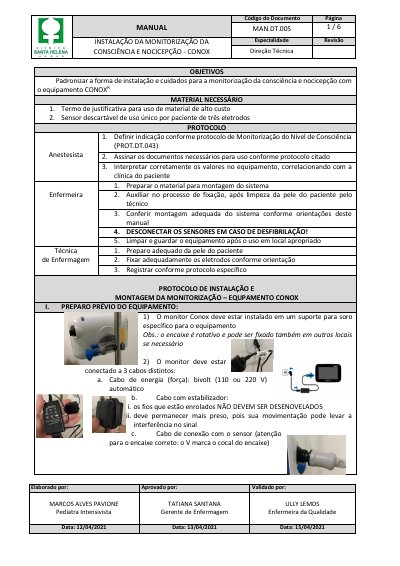
This document provides a standardized procedure for installing and operating the CONOX monitor for consciousness and nociception monitoring. It details required materials, roles for anesthesiologists, nurses, and technicians, equipment setup, skin preparation, sensor fixation locations, and impedance verification.
The guide also explains the monitor's main screen indices (qCON, qNOX, BSR, EMG, SQI) with ideal ranges, basic interpretation guidelines, Bluetooth connectivity for data export via the CONOX VIEW Android app, accessing stored monitoring sessions, and safe sensor removal and storage, including a critical warning to disconnect sensors during defibrillation. This manual is written in Portuguese.
| Power Supply | Bivolt automatic (110/220 V) |
|---|---|
| Sensor Impedance Ideal | ≤5 kΩ |
| qCON Index Range | 40–60 (consciousness level) |
| qNOX Index Range | 40–60 (nociception level) |
| BSR Index Ideal | Zero (suppression rate) |
| EMG Index Ideal | <70 (facial movement) |
| SQI Signal Quality Ideal | 100 (acceptable >80) |
| Bluetooth Connectivity | Yes, with CONOX VIEW app (Android only) |
| Bluetooth Pairing Password | Serial number (e.g., 24810884) |
The ideal impedance for all three electrodes is ≤5 kΩ; values between 6–10 kΩ require re-preparation, and above 10 kΩ triggers a 'TH' reading requiring mandatory re-fixation.
Yes, the monitor has Bluetooth and can pair with the CONOX VIEW app on Android devices using the equipment's serial number as the password.
qCON monitors the level of consciousness (ideal 40–60), while qNOX monitors nociception (ideal 40–60) and helps determine the optimal moment for laryngoscopy.
Sensors must be disconnected during defibrillation to avoid burns on the patient's forehead.