
The invention discloses a plant essential oil for preventing and controlling tsutsugamushi disease caused by a new species of Leptotrombidium, which comprises the following components in parts by weight: 2-20 parts of thymol, 1-10 parts of eugenol, 1-10 parts of methyl eugenol, 0-15 parts of apiol, 1-20 parts of cinnamaldehyde, 0.1-2 parts of sanguinarine and 0.1-2 parts of hypericin. According to the characteristics of various plant essential oils, the present invention screens out the optimal proportion for tsutsugamushi disease caused by a new species of Leptotrombidium in chickens;复配由多种植物精油进行复配,并具有非常好的抗菌效果,而 且百里香酚和肉桂醛的质量比为5:1时有显著的 协同增效作用,使药物安全、绿色、高效,无毒副 作用和无抗药性,无残留,无配伍禁忌。
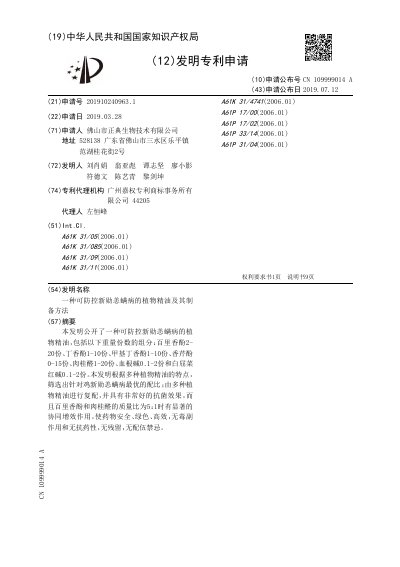
This is a Chinese patent application filed by Zhengdian Biotechnology (佛山市正典生物技术有限公司) for a plant essential oil formulation and its preparation method. The document describes a composition containing thymol, eugenol, methyl eugenol, carvacrol, cinnamaldehyde, sanguinarine and chelerythrine, with weight ranges given in the claims and description.
It also describes preparation by mixing the components, extraction of chelerythrine and sanguinarine with ethanol under ultrasound, and dosage forms such as solution, microemulsion, powder, premix, granules, tablets or microcapsules. The text discusses use for chicken Xinxun mite disease and administration by spraying, dipping, or scattering on litter. This manual is written in Chinese.
| Thymol content | 2–20 parts by weight |
|---|---|
| Eugenol content | 1–10 parts by weight |
| Methyl eugenol content | 1–10 parts by weight |
| Carvacrol content | 0–15 parts by weight |
| Cinnamaldehyde content | 1–20 parts by weight |
| Sanguinarine content | 0.1–2 parts by weight |
| Chelerythrine content | 0.1–2 parts by weight |
| Preferred formulation | Thymol 5, eugenol 2, methyl eugenol 1, carvacrol 2, cinnamaldehyde 3, sanguinarine 0.5, chelerythrine 0.3 parts by weight |
| Dosage forms | Solution, microemulsion, powder, premix, granules, tablets or microcapsules |
| Synergistic mass ratio | Thymol to cinnamaldehyde 5:1 |
It is used to prevent and control chicken Xinxun mite disease, which is caused by parasitic larvae of the Xinxun mite.
The formulation contains thymol, eugenol, methyl eugenol, carvacrol, cinnamaldehyde, sanguinarine and chelerythrine.
It can be prepared as a solution, microemulsion, powder, premix, granules, tablets or microcapsules.
Yes; a thymol to cinnamaldehyde mass ratio of 5:1 is described as significantly synergistic.