
ETCR3600 Intelligent equipotential tester is a special instrument for testing the quality of equipotential connection between metal components in buildings (lightning protection belt, foundation beam, structure, protection, floor筋, water pipe, radiator, toilet, kitchen, etc.).
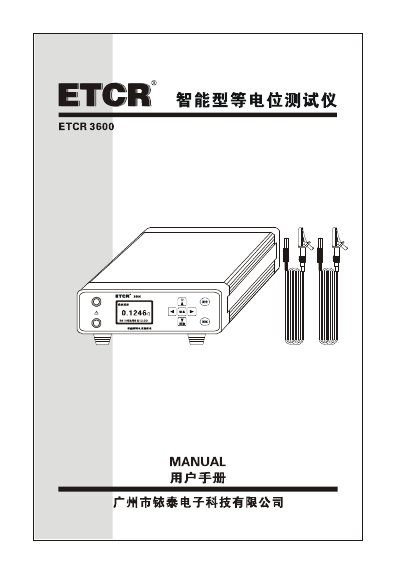
The ETCR3600 intelligent equipotential tester is a dedicated instrument for testing equipotential bonding resistance between metal components in buildings, and for measuring low resistances such as grounding conductor resistance and contact resistance. It has a 128×64 dot LCD, a Chinese operating interface, and can store up to 6000 groups of data.
This user manual covers warnings, technical specifications, instrument structure, basic operation (power on/off, lead resistance verification, testing, reset, backlight), system settings (time, alarm, storage), other operations (data review, deletion, RS232 upload), battery charging, and the packing list. This manual is written in Chinese.
| Power supply | DC6V 1.2Ah rechargeable battery |
|---|---|
| Measurement power | ≤10W; maximum operating current ≤1A |
| Detection method | 2-channel A/D simultaneous detection |
Charge for about 8 to 10 hours and do not exceed 20 hours.
No. It has no automatic power-off function, so switch it off after use to avoid draining the battery.