
Anti-seepage and freeze-thaw concrete is a new type of concrete with good anti-seepage, anti-freeze and anti-corrosion properties. It is mainly used in water conservancy, underground foundation, roof waterproofing, building structure in low temperature area, artificial ice surface bearing layer and bridge, culvert, road, water conservancy project and other projects with anti-seepage and anti-freeze requirements.
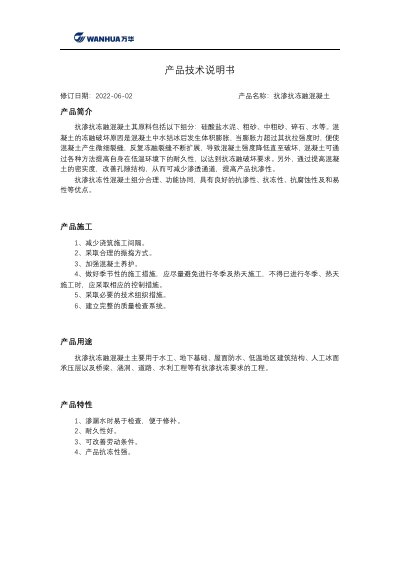
This document is a product technical specification (产品技术说明书), revised 2022-06-02, for anti-seepage and freeze-thaw concrete (抗渗抗冻融混凝土). It describes the product's raw materials, which include Portland cement, coarse sand, medium-coarse sand, crushed stone and water, and explains how freeze-thaw damage occurs when water expands as it freezes inside concrete, forming micro-cracks that grow with repeated cycles.
The specification outlines construction measures such as reducing intervals between pours, proper vibration, curing, and seasonal precautions for winter and hot-weather work, along with a quality inspection system. It lists typical applications including hydraulic works, underground foundations, roof waterproofing, structures in low-temperature regions, artificial ice surface load-bearing layers, bridges, culverts and roads, and notes features such as good durability, strong frost resistance and easy leak inspection and repair. This manual is written in Chinese.
| Raw material components | Portland cement, coarse sand, medium-coarse sand, crushed stone, water, etc. |
|---|---|
| Revision date | 2022-06-02 |
It is mainly used in hydraulic works, underground foundations, roof waterproofing, building structures in low-temperature regions, artificial ice surface load-bearing layers, and bridges, culverts, roads and other projects requiring anti-seepage and frost resistance.
Water inside the concrete expands when it freezes; when the expansion force exceeds the tensile strength, micro-cracks form and keep growing with repeated freeze-thaw cycles, reducing strength until failure.
It recommends reducing intervals between pours, using proper vibration methods, strengthening curing, taking seasonal measures to avoid winter and hot-weather construction where possible, applying necessary technical and organizational measures, and establishing a complete quality inspection system.