
This kit uses alkaline lysis to lyse cells and specifically extracts plasmid DNA based on the principle that the centrifuge adsorption column specifically binds DNA in the solution under high salt conditions.
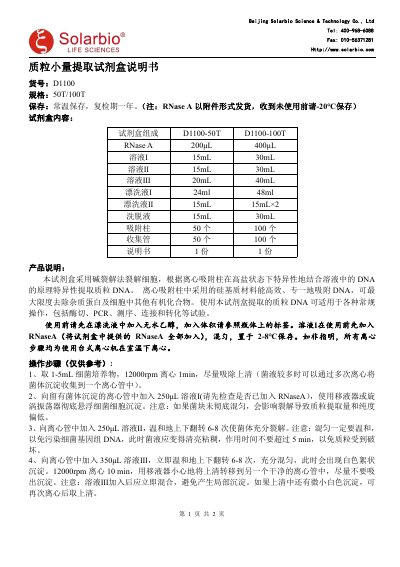
This is the Chinese-language instruction manual for the Solarbio plasmid mini extraction kit, catalog number D1100, supplied in 50T and 100T sizes by Beijing Solarbio Science & Technology Co., Ltd. The kit is stored at room temperature and is valid for one year, with RNase A shipped as a separate accessory to be kept at -20°C before use.
The manual lists the kit components (Solution I-III, two wash solutions, eluent, adsorption columns and collection tubes) and explains the alkaline lysis principle: cells are lysed and plasmid DNA is selectively bound by a silica-based adsorption column under high-salt conditions. Step-by-step centrifugation instructions cover bacterial harvest, lysis, binding, washing and elution, and the extracted plasmid DNA is suitable for routine work such as restriction digestion, PCR, sequencing, ligation and transformation. Precautions cover adding ethanol to the wash solutions, elution volume and pH, and handling low-copy or plasmids larger than 10 kb. This manual is written in Chinese.
| Catalog Number | D1100 (50T / 100T) |
|---|---|
| Storage | Room temperature, valid for one year; RNase A at -20°C before use |
| Kit Contents (50T) | RNase A 200μL, Solution I 15mL, Solution II 15mL, Solution III 20mL, Wash Solution I 24ml, Wash Solution II 15mL, Eluent 15mL, 50 adsorption columns, 50 collection tubes |
| Sample Volume | 1-5 mL bacterial culture (5-10 mL for low-copy or >10 kb plasmids) |
| Centrifugation | 12,000 rpm, room temperature, benchtop centrifuge |
| Elution Volume | 50-200 μL eluent pre-warmed to 65°C |
| DNA Purity (OD260/OD280) | 1.7-1.9 |
RNase A is shipped as a separate accessory and should be stored at -20°C until it is used.
Heat the solution in a 37°C water bath for a few minutes until it becomes clear again before use.
The elution buffer volume should not be less than 50μL, since smaller volumes reduce recovery efficiency; the pH should be around 8.0.
Use 5-10 mL of overnight culture and proportionally increase the amounts of Solution I, Solution II and Solution III.