
This manual describes the usage, experimental design, and operation steps for the Solarbio CA1020 Annexin V-FITC/PI Apoptosis Detection Kit.
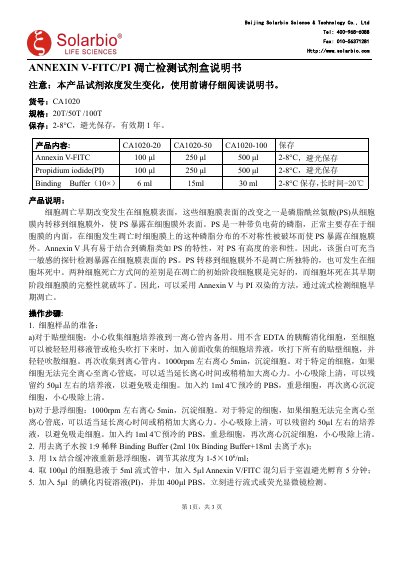
The Solarbio CA1020 Annexin V-FITC/PI Apoptosis Detection Kit is designed to detect cell apoptosis using the Annexin V-FITC and Propidium Iodide (PI) double staining method. The kit relies on the exposure of phosphatidylserine (PS) on the cell membrane surface during early apoptosis, which Annexin V binds to with high affinity. PI is used to stain dead cells with compromised membrane integrity. The results can be analyzed using flow cytometry or fluorescence microscopy. This manual is written in Chinese.
| Catalog Number | CA1020 |
|---|---|
| Storage Temperature | 2-8°C |
| FITC Excitation Wavelength | 488nm |
| FITC Emission Wavelength | 525nm |
| PI Excitation Wavelength | 535nm |
Yes, because Annexin V binds to phosphatidylserine (PS), which shows no difference across different species.
Adding PI first is not recommended because it is toxic to cells and increases staining error over time.